 listicle
Best Used Dozer Brands 2026: Buying Guide
Table of Contents
- Top Used Dozer Brands Compared
- Caterpillar Dozers: Industry Standard
- Komatsu Dozers: Advanced Technology
- John Deere, CASE, and Liebherr Options
- Used Bulldozer Inspection Checklist
- Heavy Equipment Auctions and Where to Buy
- Dozer Financing Options for Used Equipment
- Total Cost of Ownership and Depreciation
- Frequently Asked Questions
Last Updated: September 4, 2026
When you're shopping for a used dozer, the brand matters more than most equipment purchases. Caterpillar, Komatsu, John Deere, CASE, and Liebherr dominate the market for good reason, each brings distinct advantages in parts availability, resale value, and operating efficiency. At Equipment Finance Academy, we help contractors and equipment dealers navigate the heavy equipment market with speed and confidence. Below, we'll break down the best used dozer brands 2026 and what actually separates a smart purchase from an expensive mistake.
Top Used Dozer Brands Compared
The used dozer market rewards buyers who understand what they're comparing. A five-year-old Caterpillar D6T and a five-year-old Komatsu PC650 aren't just different machines, they represent different philosophies about power delivery, fuel efficiency, and long-term ownership costs. Your choice depends on whether you prioritize maximum resale value, lowest operating costs, or specialized features like precision grading.
Quick Comparison Table
| Brand | Typical Use Case | Key Strength | Main Trade-off |
|---|---|---|---|
| Caterpillar | Heavy earthmoving, mining | Parts availability nationwide | Higher purchase price |
| Komatsu | Large-scale grading, mining | Lower fuel consumption, iMC automation | Specialized parts harder to source |
| John Deere | Finish grading, site prep | Maneuverability, ease of maintenance | Less raw power at scale |
| CASE | General construction, versatility | Balanced power-to-weight ratio | Smaller dealer network |
| Liebherr | Precision work, industrial | Superior fuel efficiency, hydrostatic drive | Premium component costs |
Caterpillar Dozers: Industry Standard
Caterpillar holds roughly 40% of the used dozer market, and that dominance isn't accidental. A used Caterpillar dozer, whether a D6, D7, or D8, carries institutional recognition. Contractors know them. Dealers stock parts. Resale value holds predictably.
The real advantage surfaces when your machine breaks down on a Friday afternoon. A Cat dealer exists within 50 miles of nearly every job site in North America. Parts for a 10-year-old D6 are cheaper and faster to source than equivalents for competing brands. This availability compounds over the machine's life. A single hydraulic pump failure that costs $8,000 in downtime on a Liebherr might cost $5,000 on a Cat because you're not waiting three weeks for a specialized component.
Caterpillar's Grade Control systems represent the precision benchmark. For contractors doing finish grading on airports or highway projects where blade accuracy matters, a used Cat with Grade Control installed often justifies the premium purchase price through faster job completion and fewer rework cycles.
The trade-off: used Caterpillar dozers command higher asking prices. Dealers know the resale story. You're paying for that market confidence upfront. Operating costs run slightly higher than Komatsu equivalents due to fuel consumption patterns on comparable horsepower models.
Komatsu Dozers: Advanced Technology
Komatsu has been steadily capturing market share from Caterpillar in the last five years, particularly among large earthmoving contractors and mining operations. The reason: fuel efficiency and Intelligent Machine Control (iMC).
A used Komatsu PC650 or PC800 running iMC automation delivers measurable fuel savings, typically 10-15% less fuel consumption than a comparable Cat on identical grading work. For operations running 2,000+ machine hours annually, that efficiency difference translates to $15,000 to $25,000 in annual fuel savings. Over a five-year ownership period, the math shifts the total cost of ownership calculation significantly in Komatsu's favor.
iMC automates blade positioning based on GPS and site elevation data. The operator sets target grades once; the system maintains blade height automatically. On large fill operations or airport construction, this reduces operator fatigue and speeds project completion. Contractors report 15-20% faster grading cycles compared to manual blade control.
The constraint: Komatsu's dealer network is smaller than Cat's. Parts availability in rural areas can lag. Specialized components sometimes require ordering from regional distribution centers rather than local stock. For a contractor in a metropolitan area with regular Komatsu support, this is a non-issue. For remote job sites, it's a meaningful limitation.
Used Komatsu dozers typically cost 8-12% less than equivalent Caterpillar models, reflecting the smaller installed base. That price advantage, combined with lower operating costs, makes Komatsu the smart pick for operators who can manage slightly longer parts lead times.
John Deere, CASE, and Liebherr Options
John Deere dozers excel at finish grading and agricultural earthmoving. The hydrostatic drive system offers superior maneuverability in tight spaces, a meaningful advantage for contractors doing site preparation on confined lots or farm-based leveling work. Used John Deere dozers run 10-15% cheaper than equivalent Caterpillar machines, making them attractive for owner-operators or small contractors managing cash flow carefully.
The limitation: John Deere lacks the raw horsepower of mining-class machines. A used John Deere 850 won't match a Caterpillar D7 on heavy push-loading applications. For general construction and finish work, it's ideal. For large-scale earthmoving, it falls short.
CASE dozers occupy the middle ground. They're reliable, fuel-efficient relative to their power output, and simpler to maintain than premium European brands. Used CASE machines cost 15-20% less than equivalent Caterpillar models. The trade-off: CASE has a smaller dealer footprint than Cat or Komatsu, and the used parts market is thinner. Hydraulic components and wear items are still available, but sourcing them takes longer.
Liebherr represents the premium European alternative. Used Liebherr dozers are rare in the North American market but command respect among contractors who've operated them. The hydrostatic drive delivers infinitely variable speed control, no gear shifting, no torque converter lag. Fuel efficiency is exceptional. Cab ergonomics are superior for operators running 10-hour shifts.
The cost barrier: used Liebherr dozers cost 30-40% more than equivalent Caterpillar machines. Specialized components cost significantly more. A Liebherr is the right choice for high-precision industrial work or mining operations where fuel efficiency justifies the premium. For general construction, the cost-benefit ratio doesn't align.
Used Bulldozer Inspection Checklist
Buying a used dozer blind is expensive. A thorough inspection catches problems before they become $50,000 repairs. The undercarriage tells the story. Track tension, sprocket wear, roller condition, and idler alignment determine remaining machine life more than engine hours alone.
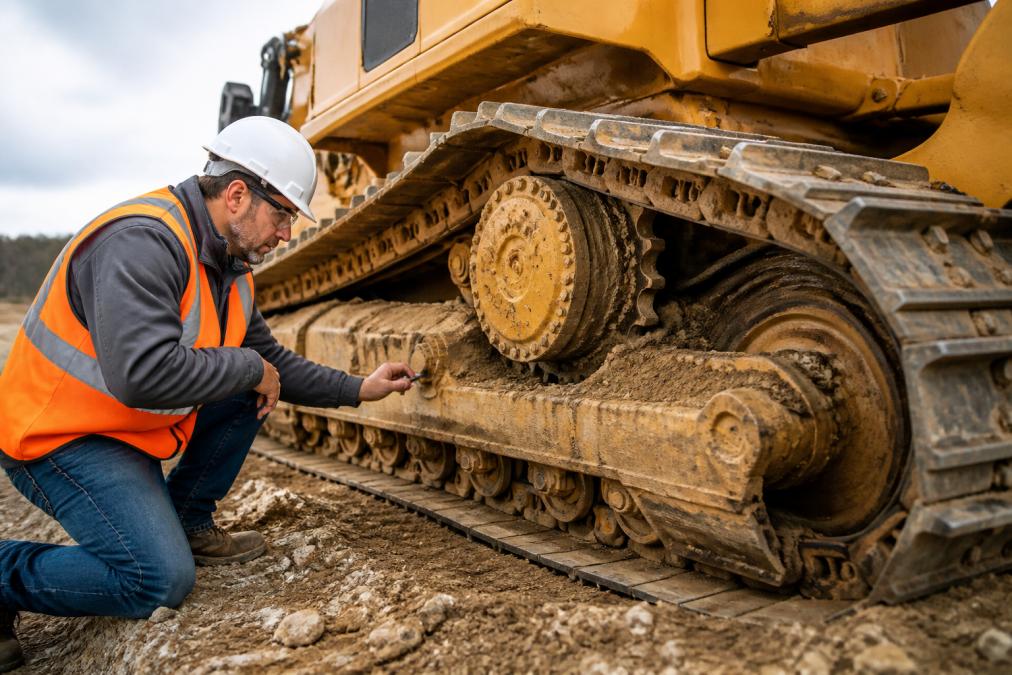
Check track tension first. Grab the track midway between sprocket and idler. It should move roughly 1-2 inches vertically. Excessive slack indicates worn rollers and sprockets, replacement costs $25,000 to $40,000 depending on machine class. Tracks that are too tight suggest recent replacement, which is good news, but also verify the work was done professionally by checking alignment.
Hydraulic pressure testing is non-negotiable. A used dozer with declining hydraulic pressure loses blade control precision and power. Request a certified technician run pressure diagnostics on all major systems: blade circuit, ripper circuit, final drive circuits. Pressure should hold steady within manufacturer specifications. Fluctuating pressure indicates internal seal wear or pump degradation.
Inspect the cab for comfort and visibility. Worn seats and poor visibility add fatigue on long shifts. Cab pressurization and air filtration matter on dusty job sites, a failed air system leads to premature engine wear.
Ground pressure and operating weight determine site compatibility. A heavy dozer sinks into soft ground; a lighter machine maintains productivity on marginal terrain. Verify the machine's specifications match your typical job site conditions.
Heavy Equipment Auctions and Where to Buy
The used dozer market operates through three primary channels: equipment dealers, heavy equipment auctions, and private sales. Each carries distinct advantages and risks.
Heavy equipment auctions (both online and in-person) offer the widest selection and competitive pricing. Machines typically sell at 10-20% discounts compared to dealer pricing because overhead is lower. The trade-off: limited inspection time, as-is sales with no warranty, and the risk of traveling to view equipment that doesn't meet expectations in person.
Reputable auction sites publish detailed equipment specifications, maintenance records, and high-resolution photos. Serious bidders request pre-auction inspections or hire independent inspectors to evaluate machines before bidding. That inspection fee ($500 to $1,500) is money well spent, it prevents catastrophic purchasing mistakes.
Dealer inventory offers convenience and recourse. A dealer typically warranties major components and handles title transfer smoothly. Dealer pricing runs 15-25% higher than auction prices, reflecting that added security and support. For contractors without heavy equipment expertise, the dealer route reduces risk significantly.
Private sales carry the highest risk but sometimes the lowest price. Buying from an operator who's upgrading equipment can yield genuine bargains, but verification is entirely your responsibility. Request maintenance records, hire an independent inspector, and verify title ownership before committing capital.
Equipment Finance Academy connects you with verified sellers across the nation's top equipment marketplaces. Our platform simplifies the inspection and negotiation process, you see accurate specs, real photos, and verified seller ratings upfront. No surprises on-site, no wasted travel.
Dozer Financing Options for Used Equipment
Financing a used dozer requires understanding your options. Traditional equipment loans from banks work, but approval timelines stretch 5-10 business days. For contractors who need equipment fast, that delay costs money.
Specialized equipment finance companies approve used dozer purchases in hours, not days. They understand the residual value of used dozers and structure loans accordingly. Typical terms run 36-60 months, with interest rates varying based on machine age, hours, and brand. Newer machines (under five years old) with lower hours qualify for better rates.
Some operators lease instead of buying. Leasing reduces upfront capital requirements and transfers maintenance responsibility to the lessor. For short-term projects or seasonal work, leasing makes financial sense. For long-term operations, ownership eventually costs less.
Down payment requirements typically range from 10-25% of purchase price. Larger down payments reduce monthly payments and interest costs but tie up working capital. Balance your cash position against the financing advantage.
Total Cost of Ownership and Depreciation
Purchase price is only one component of total cost of ownership. A $150,000 Caterpillar dozer and a $135,000 Komatsu dozer have vastly different five-year ownership costs when you factor in fuel, maintenance, parts, and resale value.
Caterpillar maintains resale value better than most brands. A five-year-old D6 typically retains 55-65% of original purchase price. Komatsu machines retain 50-60%. John Deere retains 48-55%. That resale value difference compounds over time. A $150,000 Cat that retains 60% value leaves you with a $90,000 residual. A $135,000 Komatsu that retains 55% value leaves you with a $74,250 residual. The net cost difference narrows significantly when resale is factored in.
Maintenance costs vary by brand. Caterpillar and Komatsu run similar maintenance intervals, typically 250-500 hours for filter changes and fluid service. John Deere maintenance is slightly cheaper due to simpler hydraulic systems. Liebherr maintenance is significantly more expensive due to specialized components.
Fuel consumption differences matter on high-hour machines. A Komatsu running 10-15% more efficiently than a Caterpillar saves $15,000-$25,000 over a 2,000-hour annual usage pattern. For contractors running 1,000 hours annually, that savings shrinks to $7,500-$12,500, less compelling but still meaningful.
Calculate your specific total cost of ownership by estimating annual operating hours, regional fuel costs, expected maintenance intervals, and anticipated resale value. That analysis often reveals that the cheapest purchase price doesn't yield the lowest five-year cost.
Buying a used dozer requires balancing purchase price, operating efficiency, parts availability, and resale value. Caterpillar remains the safe choice for contractors who prioritize maximum support and predictable resale. Komatsu wins on fuel efficiency and automation features. John Deere, CASE, and Liebherr serve specific niches well but lack the broad market appeal of the top two.
Equipment Finance Academy accelerates your buying process by connecting you with verified sellers, transparent pricing, and financing approvals in hours. Whether you're upgrading your fleet or building one from scratch, we help you find the right used dozer at the right price, with the financing in place to close fast. Start selling today and access the nation's top equipment lenders.
Frequently Asked Questions
Which used dozer brand holds its value best?
Caterpillar dozers typically command the strongest resale value due to their extensive parts availability, large dealer network, and reputation for reliability. Komatsu machines also retain value well, particularly in mining and large-scale earthmoving operations. The brand's residual value depends on operating hours, maintenance history, and local market demand. Check recent auction results and dealer listings to compare current depreciation trends for the specific model year and horsepower class you're considering.
How many operating hours should I expect from a used dozer?
A well-maintained used dozer can operate effectively for 10,000 to 15,000 hours or more. Machines with 5,000 to 8,000 hours remain in mid-life condition, while units exceeding 12,000 hours require closer inspection of the undercarriage, hydraulic system, and powertrain. Operating hours alone don't determine remaining lifespan; service intervals, maintenance records, and the type of work performed matter significantly. Request full service history and diagnostic software readouts before purchase to assess true mechanical condition.
What should I look for when inspecting a used dozer?
Prioritize undercarriage inspection: check track tension, sprockets, rollers, and idlers for wear. Examine hydraulic pressure readings and hose condition. Test the blade capacity, ripper attachment functionality, and ground pressure distribution. Review maintenance records for preventative maintenance compliance and emissions compliance certifications. Verify the torque converter and final drive operate smoothly. Request a pre-purchase inspection report from a certified technician and compare the machine's specifications against manufacturer standards for its model year and horsepower rating.
Are older Caterpillar dozers still worth buying?
Older CAT dozers can be a solid investment if they have low-to-moderate operating hours and complete maintenance records. CAT's extensive parts availability and strong dealer support network make repairs and serviceability easier than with less-common brands. However, assess the specific machine's condition thoroughly: check for corrosion, hydraulic leaks, and transmission wear. Older models may lack advanced Grade Control systems and diagnostic software found in newer units, which could affect grading accuracy on precision projects. Compare total cost of ownership, including fuel consumption, service intervals, and expected remaining lifespan, against newer alternatives.
What financing options are available for used dozers?
Equipment financing for used dozers typically includes term loans, lease-to-own arrangements, and equipment-specific credit lines. Lenders evaluate the machine's age, operating hours, residual value, and your business credit history. Approval timelines vary; some specialized equipment finance marketplaces offer approvals in hours with same-day funding. Interest rates depend on the dozer's condition, loan term, and down payment amount. Compare rates across multiple lenders before committing, and ensure the financing term aligns with the machine's expected useful life to avoid underwater loan situations.