 how-to
Buying Used Excavators for Small Business: A Complete Guide
Table of Contents
- Why Small Businesses Buy Used Excavators
- Used Excavator Inspection Checklist: What to Look For
- Total Cost of Ownership for Used Excavators
- Equipment Financing for Small Business
- Section 179 Tax Deduction for Heavy Machinery
- Verifying Serial Numbers and Preventing Equipment Theft
- Insurance and Liability Considerations
- Common Mistakes When Buying Used Excavators
- Frequently Asked Questions
Last Updated: September 19, 2026
Why Small Businesses Buy Used Excavators
Buying used excavators for small business makes financial sense when capital is tight. A new compact excavator costs $100,000+; a well-maintained used model might cost half that, freeing cash for payroll and operations.
Used equipment lets you test whether a machine type fits your workflow before committing serious money, without the depreciation hit of a new purchase.
Buying used excavators requires discipline. Equipment that looks fine may have hidden hydraulic damage, worn undercarriage, or falsified hours. A thorough inspection and honest maintenance records separate good deals from money pits.
Used Excavator Inspection Checklist: What to Look For
Inspect used excavators systematically by category. Bring a flashlight, wear gloves, and request complete documentation from the seller.
Hydraulic System and Undercarriage Condition
The hydraulic system is critical. Check hoses and connections for leaks or discolored fluid. Operate the boom, stick, and bucket through their full range, smooth, responsive movement is good; jerky or delayed response signals pump or cylinder wear.
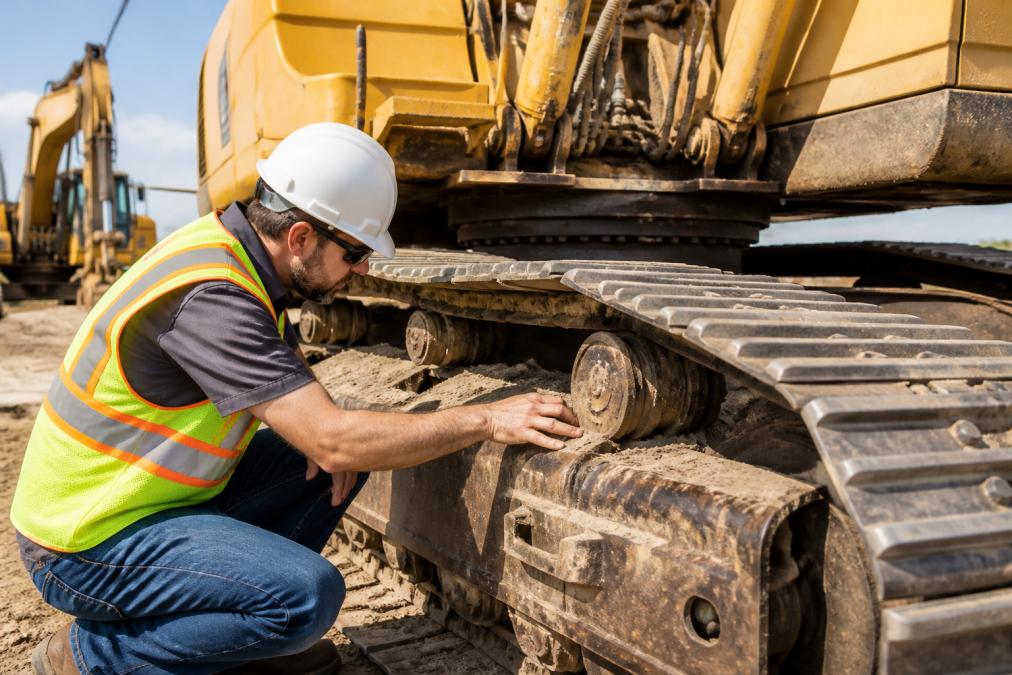
Inspect tracks for wear, missing links, or bent rollers (replacement costs $3,000-$8,000). Spin idler wheels and sprockets by hand, they should turn freely. Check the swing bearing for clicking or grinding sounds during rotation.
Engine Hours and Maintenance Records
A compact excavator with 3,000-5,000 hours is mid-life; above 8,000 hours, expect frequent maintenance and major repairs. Request service records and cross-reference claimed hours against the maintenance log. Gaps or sudden jumps in hours are red flags.
Structural Integrity and Wear Indicators
Examine the boom, arm, and bucket for cracks, bends, or recent welds. Check the cab for frame cracks and ensure hydraulic cylinders are straight, bent cylinders leak and reduce precision.
Check for deep pitting that weakens structure, especially at the boom base and connection points between upper and lower structures.
Total Cost of Ownership for Used Excavators
Purchase price is only the beginning. Operating costs include fuel, maintenance, repairs, storage, insurance, transportation, and licensing. Calculate total cost of ownership (TCO) before committing capital.
Fuel Consumption and Operating Costs
A compact excavator burns 4-6 gallons per hour; at 40 hours weekly, budget $560-$840 monthly for fuel. Larger excavators consume 8-12 gallons per hour, pushing costs to $1,200-$1,800 monthly.
Operator wages ($25-$35/hour, or $1,000-$1,400 weekly) must be factored into project pricing.
Maintenance and Repair Reserves
Low-hour machines cost $1,500-$2,500 annually; high-hour machines cost $4,000-$6,000. Set aside 10-15% of purchase price annually for repairs, $5,000-$7,500 for a $50,000 excavator.
Major repairs: hydraulic pump ($2,500-$5,000), swing bearing ($3,000-$6,000), track ($3,000-$8,000), engine overhaul ($4,000-$8,000). Detailed maintenance logs help predict failures and avoid emergency repairs.
Transportation and Logistics
Transporting an excavator costs $500-$2,000 per move; twice monthly adds $1,000-$4,000 in logistics costs.
Verify job sites have adequate access and check weight restrictions with your local Department of Transportation. Violating limits can result in fines ($500-$5,000+).
Some states require special licensing or CDL for equipment operators above certain weight thresholds. Verify requirements before purchasing.
Storage and Security
Outdoor storage costs $50-$150 monthly; indoor storage $150-$300. For seasonal work, budget $600-$3,600 annually. Some operators share yard space or store at active job sites.
Insurance and Registration
Equipment insurance costs 3-8% of machine value annually ($1,500-$4,000 for a $50,000 excavator). Registration and licensing run $200-$500 yearly.
Building a TCO Model
Create a simple spreadsheet to track all costs:
| Cost Category | Monthly | Annual |
|---|---|---|
| Fuel | $600-$1,000 | $7,200-$12,000 |
| Operator wages | $1,000-$1,400 | $12,000-$16,800 |
| Maintenance reserve | $400-$600 | $4,800-$7,200 |
| Transportation (avg) | $500-$1,000 | $6,000-$12,000 |
| Storage | $50-$150 | $600-$1,800 |
| Insurance | $125-$330 | $1,500-$4,000 |
| Registration/licensing | $20-$40 | $200-$500 |
| Total Monthly | $2,695-$4,520 | $32,300-$54,300 |
For a $50,000 used excavator, you're looking at $32,000-$54,000 in annual operating costs. Equipment generating $60,000-$80,000 annually is profitable; $30,000 is a loss.
Equipment Financing for Small Business
If you lack cash to buy outright, specialized equipment lenders understand machinery value and depreciation better than banks.
Specialized lenders move faster with flexible approval criteria. Equipment Finance Academy provides Quick Equipment Financing. Access the nation's top equipment lenders and tech-powered financing marketplace. Approvals in hours, funding same-day.
Compare loan terms, down payment requirements, and whether you can add equipment to existing credit lines. Some lenders offer better rates for multiple pieces.
Section 179 Tax Deduction for Heavy Machinery
Section 179 allows deducting the full purchase price in the year of purchase (2026 limit: $1,160,000). This significantly reduces taxable income if you're profitable.
Used equipment qualifies if placed in service during the tax year. Consult a tax professional, as rules vary by business structure and income level.
Verifying Serial Numbers and Preventing Equipment Theft
Verify the excavator's serial number against manufacturer records and title documents. Cross-reference with the bill of sale and previous ownership documentation.
Run a theft check through the National Equipment Register to prevent buying stolen equipment and legal liability.
Keep detailed records of serial number, photos, and maintenance logs. Mark equipment with permanent identifiers in multiple locations.
Insurance and Liability Considerations
Operating heavy equipment carries significant liability risk. Equipment insurance covers physical damage; liability insurance covers injury or property damage caused by the equipment. Inadequate insurance can mean bankruptcy.
Understanding Coverage Types
Three main insurance categories:
-
Equipment/Physical Damage Insurance, Covers collision, theft, vandalism, fire, or weather. Deductibles range $500-$2,500. Older equipment may have higher premiums.
-
General Liability Insurance, Covers bodily injury and property damage. Standard limits: $1 million per occurrence, $2 million aggregate. Costs $800-$2,000 annually.
-
Workers' Compensation Insurance, Required if you have employees. Covers medical expenses and lost wages. Rates typically 10-20% of payroll.
Verifying Your Current Coverage
Before purchasing, contact your insurance agent and ask: Does my policy cover this equipment? Are there age or hour exclusions? Are coverage limits adequate? Does it cover multiple job sites and equipment in transit?
Underwriting Challenges for Used Equipment
Insurers ask about age, hours, maintenance history, previous damage, intended use, and operator type. Equipment with spotty records may be declined or charged 20-40% higher premiums.
If you're financing the purchase, the lender will require proof of insurance before releasing funds.
Equipment-Specific Policies
-
Breakdown/Mechanical Failure Coverage, Covers the cost of repairs if the engine, hydraulic system, or other major components fail unexpectedly. This is valuable for older equipment and typically costs $50-$150 per month depending on the machine's value and age.
-
Theft and Vandalism Coverage, Protects against equipment theft, which is common in construction. Deductibles are usually $500-$1,000. If your equipment is stolen, the insurer covers the loss minus the deductible.
-
On-Site Storage Coverage, Covers equipment left at job sites overnight or during weekends. Standard liability policies may not cover equipment stored off your primary location.
-
Operator's Liability, Some policies include coverage for injuries caused by operator error, which is separate from general liability.
Documenting Equipment for Insurance Purposes
Keep detailed records of your excavator for insurance purposes:
- Serial number and manufacturer
- Purchase date and price
- High-resolution photos of the equipment from multiple angles
- Maintenance and repair logs
- Operator training certifications
- Any modifications or attachments
Liability Limits and Job-Specific Risk
Cost of Insurance in Your TCO
Common Mistakes When Buying Used Excavators
Rushing the purchase is the biggest mistake. Pressure from the seller ("I have another buyer interested") or urgency from your own schedule leads to skipped inspections and missed red flags. Take the time to do the work right. A thorough inspection takes a few hours. A bad purchase costs months of frustration and thousands in unexpected repairs.
Frequently Asked Questions
What should I check first when inspecting a used excavator?
Start with engine hours and maintenance records, these reveal the machine's operating history and preventative maintenance patterns. Then inspect the hydraulic system for leaks, test the swing bearing, and check track tension. Finally, verify the serial number against the title and run a theft check. A complete inspection takes 1-2 hours but prevents costly repairs after purchase.
How does equipment financing for small business work?
Equipment financing allows you to spread the cost of a used excavator over time rather than paying upfront. Lenders typically require 10-20% down and finance the remainder at fixed rates. Terms usually range from 24 to 84 months. Equipment Finance Academy provides Quick Equipment Financing. Access the nation's top equipment lenders and tech-powered financing marketplace. Approvals in hours, funding same-day, giving small contractors fast access to capital without depleting cash reserves.
Can I claim a Section 179 tax deduction for a used excavator?
Yes. Section 179 allows you to deduct the full purchase price of qualifying used business equipment in the year you place it in service, rather than depreciating it over years. For 2026, the deduction limit is $1,160,000 (subject to annual adjustments). Consult your tax professional to confirm eligibility and ensure proper documentation of the purchase and business use.
What are the biggest risks when buying used heavy equipment?
The main risks are hidden mechanical problems (hydraulic leaks, worn tracks, engine damage), inaccurate maintenance records, theft history, and underestimating total operating costs. Buying from unverified sellers increases fraud risk. Mitigate these by obtaining a pre-purchase inspection from an independent mechanic, verifying the serial number, checking the title, and understanding the machine's full cost of ownership before committing.