 how-to
Calculating Total Cost of Ownership for Used Excavators
Table of Contents
- What Total Cost of Ownership Really Means for Used Excavators
- Used Excavator Maintenance Costs: The Biggest Variable in Your TCO
- Used Excavator Financing Options and How They Change Your Total Cost
- IRS Section 179 Deduction for Used Equipment: What Buyers Need to Know
- Depreciation Curves, Telematics, and Component Life: Angles Most Buyers Miss
- Building Your Own TCO Worksheet for Used Excavators
- Conclusion
- Frequently Asked Questions
Last Updated: September 16, 2026
What Total Cost of Ownership Really Means for Used Excavators
Calculating total cost of ownership for used excavators means adding up every dollar a machine consumes from purchase to resale, not just the sticker price. The real figure includes fuel, undercarriage wear, hydraulic repairs, insurance, financing interest, and resale value.
Total cost of ownership (TCO) is the sum of every cost associated with acquiring, operating, maintaining, and disposing of a piece of equipment over a defined ownership period. It converts a purchase decision into a cost-per-hour decision, the only fair way to compare two machines.
The TCO Formula You Can Actually Use
TCO = Acquisition Cost + Operating Costs + Maintenance and Repair Costs + Financing Costs + Insurance and Taxes − Resale Value
- Acquisition cost: purchase price plus buyer's fees, transport, and any immediate repairs
- Operating costs: fuel, lubricants, wear parts, and operator labor
- Maintenance and repair costs: planned service plus unplanned breakdowns
- Financing costs: interest and fees if you borrow rather than pay cash
- Insurance and taxes: annual premiums and any applicable personal property tax
- Resale value: what the machine is worth when you sell it
Run this formula per hour to get your true cost per hour, the number that determines whether a job makes money.
Used Excavator Maintenance Costs: The Biggest Variable in Your TCO
Used excavator maintenance costs are the hardest line item to predict and usually the one that breaks a budget. A flat annual figure is a common mistake: maintenance cost climbs with machine hours, age, and operating environment, arriving in uneven spikes rather than a smooth monthly bill.
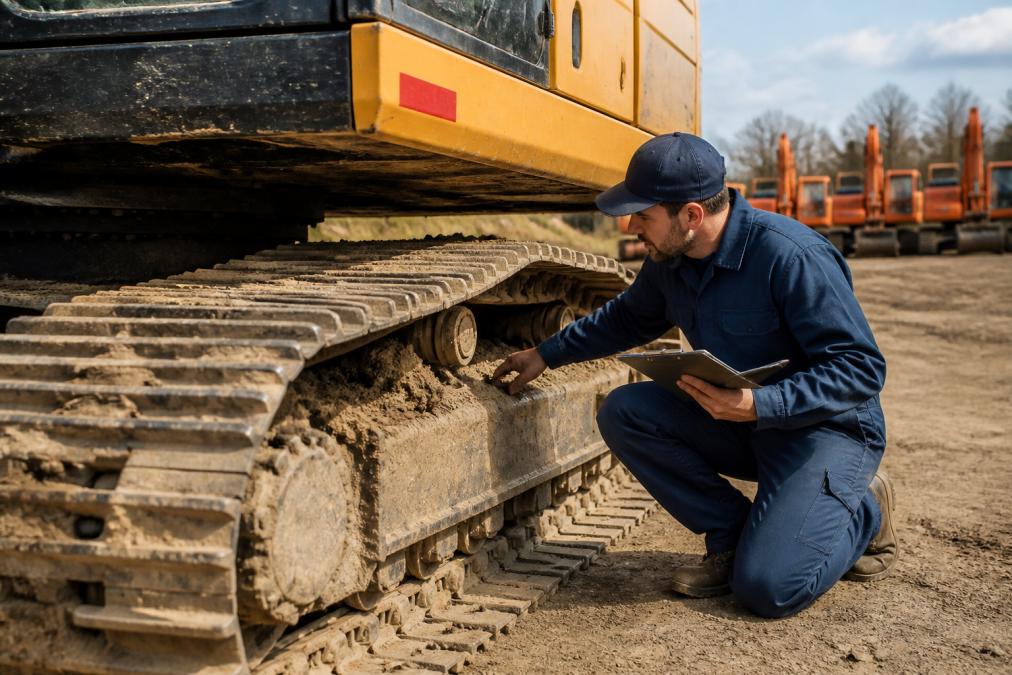
Undercarriage Wear and Hydraulic System Health
Undercarriage wear and hydraulic system health are where used machines hide their biggest future bills. Tracks, rollers, idlers, and sprockets wear continuously and are expensive to replace as a set, so inspect track tension, roller condition, and sprocket tooth wear before you buy.
Hydraulic health matters just as much. Look for weeping cylinders, contaminated fluid, and slow cycle times, a failing hydraulic pump can cost more to repair than the price gap to a cleaner unit.
Build your maintenance budget around a planned schedule for filters, fluids, and inspections, then add an unplanned repair reserve, many buyers set it as a percentage of purchase price and adjust it based on inspection findings.
Used Excavator Financing Options and How They Change Your Total Cost
Used excavator financing options change your total cost because interest and fees are real money, but financing also preserves cash flow for fuel, payroll, and the next job. Loans, leases, and cash purchase each shift cost between upfront capital and monthly outflow, altering the TCO formula differently.
| Financing Path | Upfront Cost | Monthly Cost | Ownership at End | Best For |
|---|---|---|---|---|
| Equipment loan | Down payment | Loan payment | You own it | Long-term ownership |
| Equipment lease | Low or none | Lease payment | Option to buy | Short-term or seasonal work |
| Cash purchase | Full price | None | You own it | Strong cash reserves |
How Interest and Term Length Actually Change Your TCO
Most buyers compare financing offers on the monthly payment, the wrong number. What belongs in your TCO formula is total interest paid across the full term, because that line item is pure added cost.
On a fixed-rate installment loan, interest is front-loaded: early payments go mostly to interest, not principal. Sell in year two of a five-year loan and you may still owe close to the original balance. The gap between what you owe and what the machine is worth is your equity position, and it can be negative on a long-term loan against a depreciating used machine.
- Rate. Even a small difference compounds over a multi-year term; a one-point difference on a five-year loan is real money added to your TCO.
- Term length. A longer term lowers the monthly payment but raises total interest and the risk of being underwater if you sell early. Match the term to your realistic ownership horizon.
- Down payment. A larger down payment reduces the financed amount, cutting total interest and improving your equity position from day one.
Cash Purchase: The Hidden Cost of Tied-Up Capital
Paying cash avoids interest entirely, a genuine TCO advantage. But cash is not free: money sunk into a used excavator cannot go to fuel, payroll, a second machine, or an emergency repair. That opportunity cost belongs in a disciplined TCO worksheet even without a dollar figure.
The practical rule: pay cash when reserves sit well above the purchase price and no higher-return use exists for the capital. Finance when the machine generates revenue faster than interest accrues and preserving cash flow protects against a slow quarter.
Lease vs. Loan: The Ownership Question
A lease keeps monthly payments lower and suits contractors needing a machine for a defined project window, but it is not ownership, you pay for the right to use the machine, not build equity. At lease end you return it, buy it out at a residual price, or roll into a new lease. The buyout price determines whether the lease beat a loan over the same period.
An equipment loan builds equity as you pay it down. At term end you own the machine outright, and its resale value flows back as a credit against your TCO, often the largest offset in the formula, which is why financing structure and resale value must be modeled together.
U.S.
Feeding Financing Into the TCO Formula
In your worksheet, financing cost is one line: total interest plus origination, documentation, or lease acquisition fees.
IRS Section 179 Deduction for Used Equipment: What Buyers Need to Know
The IRS Section 179 deduction for used equipment lets qualifying businesses deduct the cost of eligible used equipment in the year it is placed in service, rather than depreciating it over many years.
Depreciation Curves, Telematics, and Component Life: Angles Most Buyers Miss
Most TCO guides stop at the formula.
Depreciation Is Not Linear, Age Brackets Matter
Depreciation curves for used excavators are not a straight line.
Telematics: Turning Machine Data Into TCO Inputs
Telematics changes how you manage TCO by replacing estimates with recorded data.
Component Life-Cycle Analysis: Mapping Hours to Your Ownership Window
Component life-cycle analysis rounds out the picture.
Building Your Own TCO Worksheet for Used Excavators
Build your TCO worksheet before you negotiate, not after, it forces you to price the machine you are actually buying, not the one in the listing photos.
Conclusion
The hard part of buying a used excavator is not finding one.
Frequently Asked Questions
What factors are included in the total cost of ownership for heavy equipment?
Total cost of ownership includes acquisition cost, operating expenses like fuel and maintenance, depreciation, insurance premiums, tax depreciation, financing costs, and the residual or resale value at the end of ownership. For used excavators, undercarriage wear, hydraulic system health, and machine hours are especially important because they drive unplanned repair costs. A complete TCO calculation also factors in downtime and the cost per hour of operation. Many buyers focus only on the purchase price and miss these ongoing costs, which can exceed the initial investment over the machine's remaining life.
How do you calculate the depreciation of a used excavator?
Calculate depreciation by subtracting the estimated resale value from the acquisition cost, then dividing by the number of years or machine hours you expect to own it. Age-related depreciation curves show that used excavators lose value fastest in the first few years, then the curve flattens. For tax purposes, the IRS Section 179 deduction for used equipment lets you expense a large portion of the purchase price in the year you place it in service, which changes your after-tax cost. Always base resale value on comparable sales, not dealer asking prices.
What are the hidden costs of owning a used excavator?
Hidden costs include unplanned repairs, undercarriage wear, hydraulic system failures, downtime, insurance premiums, and storage or transport. Fuel consumption rate also varies with operating environment and machine utilization. A used excavator with high machine hours may need a planned maintenance overhaul sooner than expected. Telematics data can reveal actual idle time and fuel use, helping you estimate these costs before you buy. Budget 10-20% of the purchase price annually for maintenance and repairs on older machines, and verify the maintenance schedule history before committing.
How does financing impact the total cost of ownership for construction equipment?
Financing affects TCO through interest charges, loan terms, and cash flow. A shorter term means higher monthly payments but less total interest; a longer term lowers payments but increases the overall cost. Equipment financing options like loans or leases also determine whether you own the asset at the end and can claim depreciation. Cash purchases avoid interest but tie up capital that could earn returns elsewhere. Compare the after-tax cost of each option, factoring in the IRS Section 179 deduction for used equipment, to see which lowers your true cost of ownership.