 comparison
Buying Heavy Equipment at Auction: Pros and Cons
Table of Contents
- How Auction Buying Compares to Dealer Purchases
- The Case for Buying Heavy Equipment at Auction
- Risks That Come With Heavy Equipment Auctions
- Hidden Costs of Auction Equipment
- Your Heavy Equipment Auction Inspection Checklist
- Financing Heavy Equipment From Auctions
- Auction Types Compared: Which Format Fits Your Needs
- Frequently Asked Questions
Last Updated: September 14, 2026
How Auction Buying Compares to Dealer Purchases
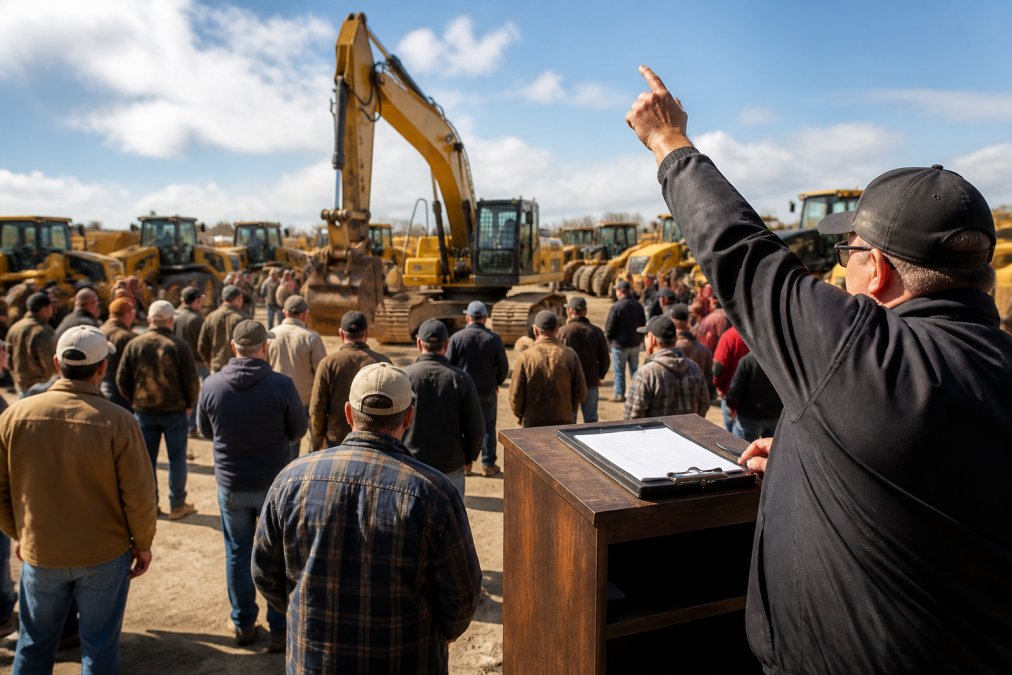
Buying heavy equipment at auction trades dealer convenience for price discovery, and that trade-off defines every decision that follows. The pros and cons of buying heavy equipment at auction come down to one question: how much diligence are you willing to do in exchange for skipping dealership markups? Auctions reward buyers who show up prepared and punish those who bid on impulse.
Dealers price in reconditioning, warranty administration, and floorplan financing costs. At auction, you absorb those risks yourself, but you also avoid paying for them upfront. That is the entire thesis. Everything else, the fees, the logistics, the inspection burden, flows from it.
| Factor | Dealer Purchase | Auction Purchase |
|---|---|---|
| Purchase price | Higher, includes markup | Lower starting point |
| Buyer premium | None | Common on hammer price |
| Warranty | Often included | Rarely included |
| Inspection | Prepped and serviced | Buyer's responsibility |
| Financing | In-house options | Third-party or specialist |
| Timeline | Immediate | Auction schedule dependent |
For contractors weighing a capital expenditure against cash flow, that table is the real decision framework. The lower entry price only matters if the hidden costs stay below the dealer premium you avoided.
The Case for Buying Heavy Equipment at Auction
The strongest argument for auctions is price transparency at scale. Unreserved formats, like those run by Ritchie Bros. Auctioneers, guarantee every item sells to the highest bidder, which removes reserve price games and gives you a genuine read on fair market value. When you watch a mini excavator or skid steer sell in front of a live crowd, you know exactly what the used market thinks it is worth that day.
Volume matters too. National platforms such as IronPlanet run weekly online auctions with consistent inventory across construction and agricultural categories, so you are not waiting months for the right telehandler to appear. Regional firms like Bright Star Auctions time events around seasonal demand, which often means local sellers liquidating equipment at the end of a project cycle.
- Asset liquidation events let fleets downsize quickly, creating supply
- Competition among bidders keeps pricing honest
- You can set a hard bidding limit before the gavel falls
That last point is the discipline auctions force on you. A dealership negotiation rewards whoever holds out longest. An auction rewards whoever walked in with a number and stuck to it.
Risks That Come With Heavy Equipment Auctions
The biggest risk is buying sight-unseen. Online listings with detailed photos and inspection reports reduce the problem, but they do not eliminate it. IronPlanet leans on its IronClad Assurance condition certification to bridge that gap, and the trade-off is real: you rely on a third party's judgment about mechanical condition rather than your own.
Mechanical failure after purchase is the consequence nobody plans for. A machine that ran fine on the auction block can develop hydraulic leaks, undercarriage wear, or transmission problems within weeks. Older, budget-focused inventory, the kind SmithCo Auctions specializes in, demands the most careful due diligence precisely because the entry price is low.
Financing adds another layer. Auction purchases close fast, often within days, and a lender who cannot move that quickly leaves you scrambling.
Hidden Costs of Auction Equipment
Auction fees are where first-time buyers get surprised. A buyer premium commonly adds a percentage on top of the hammer price, and on higher-value machines that premium is not trivial. Ritchie Bros. and similar platforms charge buyer's premiums that can push your true cost meaningfully above the number you bid.
Then come transportation costs. Moving a mini excavator across state lines requires a lowboy trailer or a hired hauler, and logistics pricing scales with distance, weight, and whether the machine runs. A non-running dozer costs more to move than one that drives onto the trailer.
- Buyer premium on the final bid
- Sales tax, which varies by state and transaction type
- Loading and rigging fees at the auction yard
- Transportation to your yard or job site
- Immediate repairs or servicing before the machine works
- Title transfer and lien search costs
That list is why the sticker price at auction is never the real price. Add every line before you set your bidding limit, not after.
Your Heavy Equipment Auction Inspection Checklist
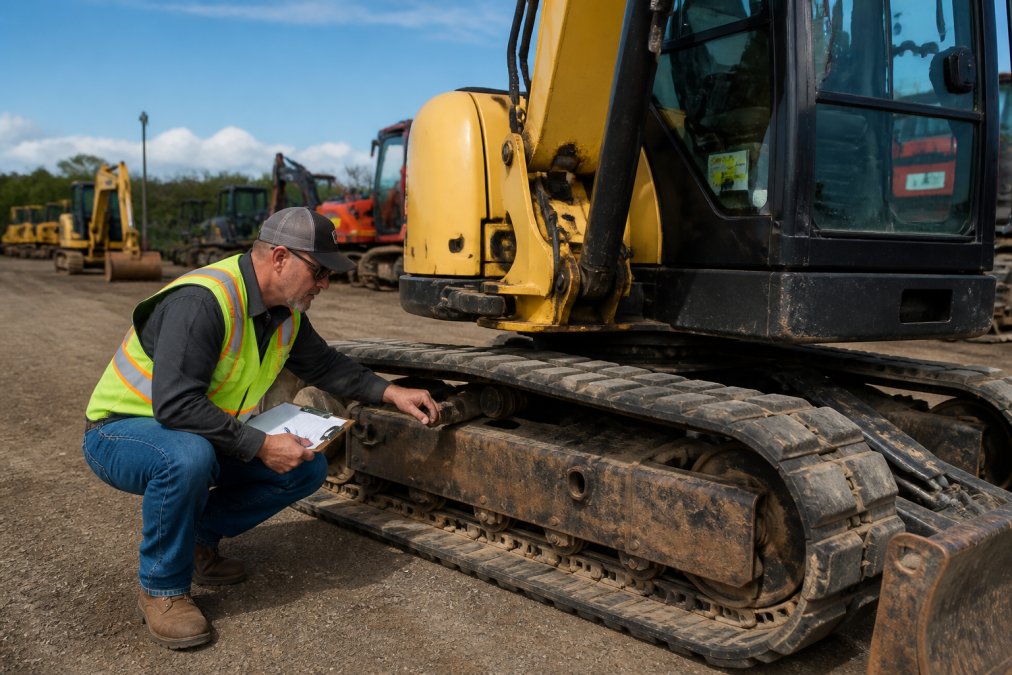
A heavy equipment auction inspection checklist is a pre-bid document that verifies condition, hours, and paperwork before you commit money. Build it once and reuse it on every machine. What separates a checklist that protects you from one that just looks thorough is the paperwork half, most buyers obsess over the undercarriage and skip the title work, which is where the expensive surprises hide.
The machine itself
- Record the serial number and verify it matches the listing, the data plate, and the frame stamp
- Confirm operating hours against the meter and service records, a meter that reads suspiciously low on an older machine is a red flag
- Inspect undercarriage, tracks, and final drives for wear; measure track sag and check sprocket teeth
- Check for hydraulic leaks, cracked hoses, and cylinder condition; look for fresh oil on the ground under the machine
- Start the engine cold and listen for unusual noise, a warm engine can mask a hard cold start
- Test every function: boom, bucket, swing, travel, auxiliary hydraulics
- Photograph any damage for your records and note it against the listing description
The paperwork, where most buyers get burned
This is the part competitors gloss over. A clean-looking machine with a dirty title is not a deal, it is a liability.
- Request the maintenance history and any equipment condition report
- Verify the title. Ask whether the machine is titled, and in which state. Equipment titled in a state that requires it (many do for over-the-road and certain off-road units) needs a clean transfer; untitled equipment transfers by bill of sale, which offers less protection.
- Run a lien search on the serial number. A UCC-1 financing statement filed against the equipment follows the machine, not the seller. If a prior lender perfected a security interest, you can buy the machine and still lose it to the lienholder. Search the state UCC records where the seller is located and where the machine has been titled.
- Check for a release from any prior lender. If a lien exists, get a written payoff and release before you bid, not after.
- Confirm warranty status, if any remains, and whether it is transferable
- Verify the seller has clear title and the legal right to transfer it
- Ask about prior insurance claims or salvage history, a rebuilt or salvage-titled machine resells for far less
That checklist is unglamorous. It is also the difference between a good deal and a repair bill, or a repossession.
Financing Heavy Equipment From Auctions
Financing heavy equipment from auctions is harder than dealer financing because the timeline is compressed and the collateral is already sold. Most traditional lenders want to inspect and appraise a machine before they fund, and an auction clock does not wait for that process. Specialist lenders who understand auction purchases move faster, but you still need pre-approval before you raise your paddle.
The practical approach is to secure financing before the auction, not after. Know your approved amount, then treat that number as your ceiling including the buyer premium and transportation. Equipment Finance Academy connects buyers with lenders who work on auction timelines, with approvals in hours and funding same-day, so the money is ready when the hammer falls.
Insurance belongs in the same conversation. Coverage should be bound before the machine leaves the yard, because a machine damaged in transit with no policy is a total loss.
Auction Types Compared: Which Format Fits Your Needs
Auction format determines how much control you have over price, inspection, and timing, and each format shifts risk in a different direction. The table below is a starting point, but the mechanism behind each row is what actually matters when you are deciding where to bid.
| Auction Type | Best For | Main Trade-off | Inspection Access | Financing Window |
|---|---|---|---|---|
| Live unreserved | High-volume buyers, fleet managers | Must attend or arrange proxy bidding | In-person day-of or preview day | Tight, often same-day close |
| Online timed | Remote buyers needing reports | Reliance on third-party inspection | Third-party report only | Days, sometimes hours |
| Regional seasonal | Local contractors, budget buyers | Limited inventory per event | Usually in-person preview | Moderate |
| Consignment | Sellers moving equipment fast | Commission reduces net proceeds | Varies by consignor | Varies |
How format changes your risk
Live unreserved sales remove reserve-price games, every item sells to the highest bidder, which gives you a genuine read on fair market value that day. The trade-off is that you must attend or arrange proxy bidding, and the close is fast. If you cannot inspect in person, you are relying on the auctioneer's description, which is not a condition guarantee.
Online timed auctions let you bid from anywhere and lean on condition reports, but the entire inspection burden shifts to a third party's judgment. A report that says "runs and operates" is not the same as a report that documents undercarriage wear or a weeping hydraulic cylinder. Read the report's scope carefully, what it covered and what it explicitly excluded.
Regional seasonal events reward local contractors who can move fast and inspect in person. Inventory is limited per event, so you may wait a season for the right machine, but the local seller base often means you can trace a machine's history through people who know it.
Consignment auctions are seller-driven, which means the seller sets terms and the auction house takes a commission. Transparency on seller history varies widely, so ask how long the consignor owned the machine and why it is being sold.
The format-to-financing link
Format and financing are not separate decisions. A live unreserved sale that closes same-day will not wait for a lender to appraise the machine, so you need pre-approval in hand before you raise your paddle. An online timed auction with a multi-day window gives a specialist lender more room to move. Match your format to your financing timeline, not the other way around.
Platforms differ in emphasis. Mid-East Equipment pairs market analysis with auction access, which helps professional resellers value a machine before bidding. SmithCo Auctions keeps transparency high on seller history, useful when you are buying older, budget-tier equipment. The right format is the one that matches your inspection capacity and your financing timeline, and the one where you can actually verify the title before the hammer falls.
Frequently Asked Questions
What are the risks of buying equipment at an auction?
The biggest risks include buying sight-unseen and discovering mechanical failure after the sale, paying more than fair market value once buyer premiums and surcharges are added, and inheriting lien or title problems. Equipment sold as-is usually carries no warranty, so a machine with high operating hours or a thin maintenance history can become a costly repair project. Inspect before bidding, verify the serial number, and set a firm bidding limit that includes all fees.
How can you inspect heavy equipment before bidding at an auction?
Request the equipment condition report and any inspection documentation the auctioneer provides, then attend the preview day in person when possible. Check the serial number against the listing, review the maintenance history, and look at undercarriage wear, hydraulic leaks, and hour meter readings. Start the machine cold if allowed. If you cannot attend, hire a third-party inspector. A heavy equipment auction inspection checklist keeps the process consistent across every machine you evaluate.
What hidden costs should you consider when buying equipment at auction?
Beyond the hammer price, budget for the buyer premium, which commonly runs 10-15% at major auctioneers, plus sales tax, loading fees, and transportation costs to move the machine. Repairs to bring the equipment to working condition, new tires or tracks, and insurance during transit add more. These hidden costs of auction equipment can push your total spend well past the winning bid, so calculate them before you set your bidding limit.
How does equipment financing work for auction purchases?
Most lenders require payment in full shortly after the auction closes, often within a few business days, so arrange financing before you bid. Pre-approval gives you a known budget and speeds up funding. Lenders typically want the equipment details, serial number, and expected purchase price. Because auction equipment is sold as-is, some lenders may require an inspection or place conditions on the loan. Financing heavy equipment from auctions works best when you start the application well before the sale date.
Auction buying rewards preparation and punishes shortcuts, and the contractors who succeed treat it as a procurement process rather than a bargain hunt. Equipment Finance Academy gives you the financing side of that process: access to top equipment lenders, approvals in hours, and same-day funding so your bidding limit is backed by real capital. Get started with Equipment Finance Academy and walk into your next heavy equipment auction knowing exactly what you can afford.