 ultimate-guide
Heavy Machinery Auction Fees Explained
Table of Contents
- What Are Heavy Machinery Auction Fees?
- Understanding Buyer's Premium Calculation
- Seller Commission Structures and Take Rate
- Heavy Equipment Auction Hidden Costs
- Auction Logistics and Transport Fees
- Calculating Total Cost of Ownership
- Fee Transparency and Negotiation Strategies
- Frequently Asked Questions
Last Updated: August 25, 2026
What Are Heavy Machinery Auction Fees?
When you're buying or selling heavy equipment through an auction, the sticker price isn't the final number you'll pay or receive. A complex layer of fees sits between the hammer price and what actually changes hands. Understanding these costs upfront separates savvy buyers and sellers from those who get blindsided at settlement.
Heavy machinery auction fees explained breaks down into several categories: buyer's premiums charged to purchasers, seller commissions taken from proceeds, administrative surcharges for processing, and logistics costs for transport and handling. Each auction house structures these differently, and the differences compound quickly on high-value equipment.
The reality is that auction fees can represent anywhere from 10% to 25% of the equipment's hammer price depending on the auction format, equipment type, and additional services required (auctioneers.org). This guide walks you through each fee category so you can calculate your true cost of ownership before you bid or list.
Understanding Buyer's Premium Calculation
The buyer's premium is the surcharge added to the hammer price that only purchasers pay. It's the auction house's primary revenue stream from buyers, and it's non-negotiable once you've won the bid. Most auction houses structure this as a tiered percentage system where the premium decreases as the hammer price increases.
How Buyer's Premium Works
A typical buyer's premium structure looks like this: 10% on hammer prices under $5,000, 8% on amounts between $5,000 and $25,000, and 5% on anything above $25,000. Some platforms charge a flat 12-15% regardless of price. The variation matters significantly when you're bidding on a $50,000 excavator versus a $500,000 crane.
The buyer's premium applies to the hammer price only, not to any other fees you'll owe. This is important for calculating your maximum bid. If you determine you can spend $100,000 total on equipment, you need to work backward through the premium structure to find your actual bidding ceiling.
Here's where most new buyers make their first mistake: they bid to their maximum budget without accounting for the premium. A $100,000 budget with a 10% buyer's premium means your actual hammer price limit is roughly $90,909. Add in transportation, inspection fees, and administrative costs, and your real equipment budget drops further.
Calculating Your Total Cost
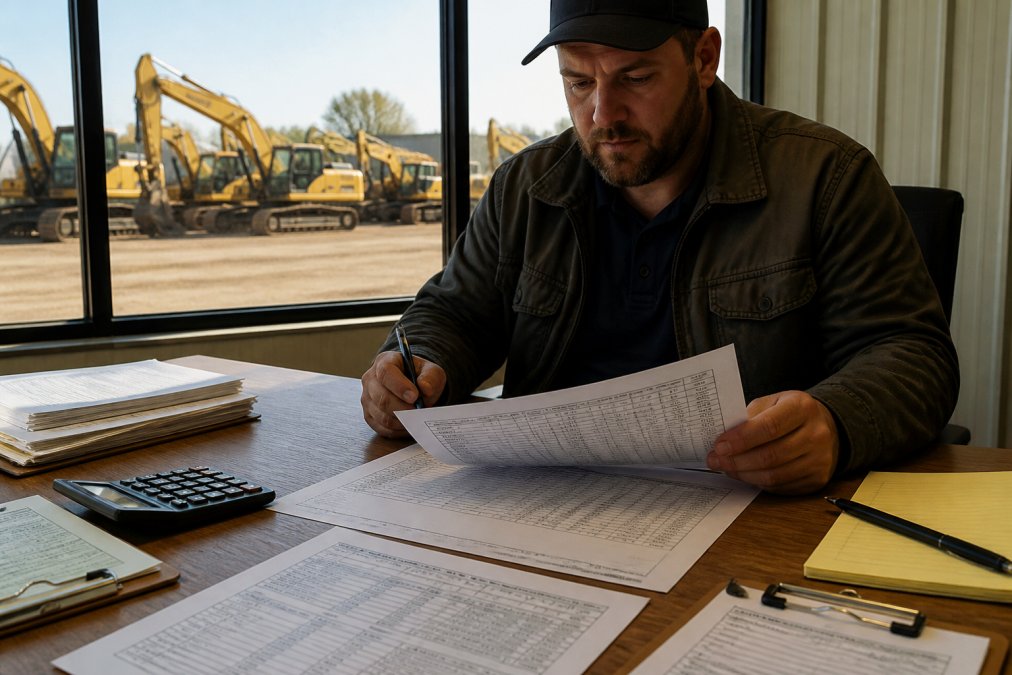
To calculate your actual total cost, multiply the hammer price by (1 + premium percentage), then add all other applicable fees. For a $50,000 hammer price with a 10% buyer's premium, your cost before other fees is $55,000. If the auction adds a $500 administrative fee and you arrange transport for $3,000, your true cost of ownership reaches $58,500.
Most auction platforms provide a fee calculator on their websites, but manual calculation gives you better control. Write down the hammer price, multiply by your tier's premium percentage, add administrative fees, add transport estimates, and add any inspection or documentation fees. That final number is what actually leaves your account.
Seller Commission Structures and Take Rate
On the selling side, the seller commission (also called the take rate) is what the auction house extracts from your gross sale price. Unlike the buyer's premium, which is transparent and tiered, seller commissions vary wildly across platforms and are often negotiable depending on your volume and equipment value.
A typical seller commission ranges from 8% to 15% of the hammer price (auctioneers.org). High-volume sellers or those moving premium equipment may negotiate rates as low as 5-7%. Solo operators selling a single piece of equipment might face commissions at the higher end. The commission is deducted from your proceeds before you receive payment, so a $100,000 sale with a 10% commission means you net $90,000.
Some auction houses bundle additional services into the commission: photography, listing management, buyer communication, and basic transportation coordination. Others charge à la carte for these services on top of the base commission. A platform charging 12% commission but including professional photography and logistics coordination may actually cost less than one charging 8% commission with separate fees for each service.
The commission structure directly impacts your net proceeds and influences which platform makes sense for your equipment. A $200,000 sale with a 10% commission costs $20,000. The same sale at 12% costs $24,000. Over multiple transactions, this difference accumulates into significant money.
Heavy Equipment Auction Hidden Costs
Beyond buyer's premium and seller commission, auctions layer on additional fees that catch people off guard. These hidden costs are where auction houses generate secondary revenue and where buyers and sellers lose track of their true expenses.
Administrative Surcharges and Reserve Prices
Administrative surcharges cover the operational costs of running the auction: payment processing, title transfer documentation, buyer and seller communication, and platform maintenance. These typically range from $200 to $1,000 per transaction depending on the equipment value and complexity.
A reserve price is the minimum acceptable bid set by the seller. If bidding doesn't reach the reserve, the equipment doesn't sell. Some auction houses charge a reserve fee ($50-$300) whether the equipment sells or not. Others waive the reserve fee if the item sells above reserve. Always clarify the reserve fee structure, some platforms charge it only if the item fails to sell, while others charge it upfront regardless of outcome.
Buyer's documentation fees cover title searches, lien verification, and ownership transfer paperwork. These run $150-$500 depending on the equipment's history and any existing liens. Equipment with clean titles costs less to document than machines with complex ownership histories or outstanding claims.
Online vs. In-Person Auction Fee Differences
Online auctions typically charge lower buyer's premiums than in-person events because the auction house has lower overhead. An online platform might charge 8-10% buyer's premium while a live auction event charges 12-15%. However, online auctions often add logistics and shipping fees that in-person buyers avoid, you're responsible for arranging transport from the auction location to your site.
In-person auctions allow you to inspect equipment before bidding, which reduces the risk of purchasing sight-unseen. This convenience is reflected in higher buyer's premiums. You're paying for the ability to see the equipment, ask questions of the auctioneer, and negotiate directly with other bidders in real time.
Some hybrid models offer live online bidding during in-person events. These typically charge in-person auction premiums (higher) but allow remote participation. The trade-off is you lose the ability to inspect equipment physically unless you arrange a pre-auction site visit.
Auction Logistics and Transport Fees
Getting equipment from the auction location to your job site involves multiple cost layers that vary dramatically based on distance, equipment weight, and access constraints.
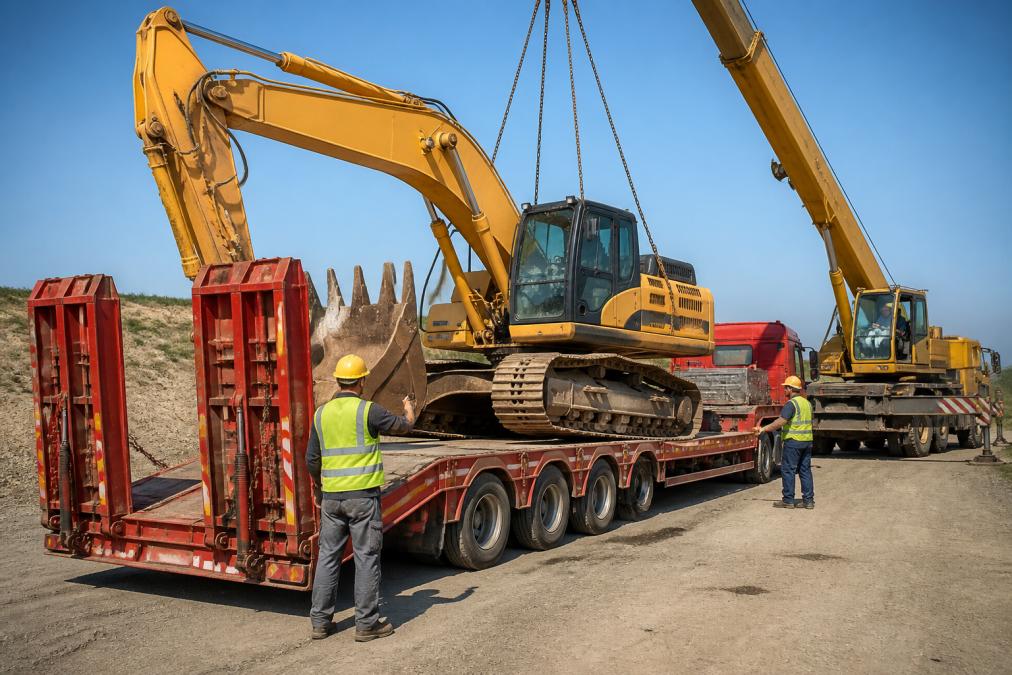
Transport fees depend on distance, equipment type, and equipment weight. A 50-ton excavator moving 100 miles costs significantly less per mile than the same excavator moving 500 miles. Most logistics companies charge by the mile plus a base fee, typically ranging from $3 to $8 per mile for heavy equipment transport (truckload.org). A 300-mile haul for a mid-size excavator might cost $2,000 to $4,000 depending on the carrier and current fuel costs.
Some auction houses include basic transport in their fees, they arrange pickup from the auction site and delivery to a designated location within a certain radius. Beyond that radius, you pay additional transport costs directly. Always clarify what "included transport" actually covers: Does it include loading and unloading? Does it cover equipment that requires special rigging? Is there a distance limit?
Specialized equipment requires specialized transport. A wheeled excavator might move on its own tracks for short distances, but a tracked dozer requires a lowbed trailer. A tower crane requires a heavy-haul rig with multiple axles. These specialized transports cost 20-40% more than standard heavy equipment transport. Factor in the equipment's specific transport requirements when budgeting.
Equipment conditioning and preparation fees cover any work needed to make the equipment transport-ready. Draining fluids, securing attachments, and applying rust protection might add $300-$1,500 depending on the equipment's condition. Auction houses sometimes include this in their logistics fees; others charge separately.
Calculating Total Cost of Ownership
Your true cost of ownership includes the hammer price, buyer's premium, administrative fees, transport, and any conditioning or inspection costs. Building a complete picture requires working through each category methodically.
Start with your target hammer price, the amount you're willing to bid. Multiply that by (1 + buyer's premium percentage). Add all administrative and documentation fees. Add your transport estimate based on distance and equipment type. Add inspection fees if you're arranging a pre-purchase inspection. This final number is what the equipment actually costs you.
Many buyers focus exclusively on the hammer price and ignore the surrounding fees, which can represent 20-30% of the total cost. A $100,000 hammer price with a 10% buyer's premium, $500 administrative fee, $3,000 transport, and $400 inspection fee totals $114,900. The fees alone add $14,900 to your actual cost.
Work backward from your budget to find your maximum acceptable hammer price. If you have $120,000 to spend, subtract transport ($3,000), administrative fees ($500), inspection ($400), and buyer's premium (10%). Your maximum hammer price is roughly $105,263. Bidding higher than that puts you over budget.
Create a spreadsheet tracking each fee category for every piece of equipment you're considering. This prevents the common mistake of comparing hammer prices across different auction platforms without accounting for their different fee structures. Platform A at $95,000 hammer price with 12% premium and $1,000 in fees costs $113,800. Platform B at $100,000 hammer price with 8% premium and $500 in fees costs $109,000. Platform B is actually cheaper despite a higher hammer price.
Fee Transparency and Negotiation Strategies
Fee transparency varies dramatically across auction platforms. Some publish complete fee schedules publicly. Others require you to contact them for pricing details. Platforms that hide their fees are usually hiding high fees.
Request a written fee estimate before you commit to bidding or listing. Include the hammer price, buyer's premium percentage, administrative fees, documentation fees, reserve fees (if applicable), and any other charges. Ask specifically about what's included in the base fees and what carries additional charges.
Negotiation opportunities exist primarily on the seller side. High-volume sellers or those moving significant equipment value can negotiate lower commission rates. Document your transaction history and approach platforms with data showing your volume. A seller moving $2 million in equipment annually has use to negotiate a 9% commission instead of 12%.
For buyers, negotiation is limited. Buyer's premiums are standardized and non-negotiable. However, you can negotiate transport costs separately if the auction house doesn't include them. You can also negotiate inspection arrangements, some platforms charge for pre-purchase inspections while others allow you to arrange your own at no platform fee.
Request fee waivers or reductions for specific circumstances. Some platforms waive reserve fees if you agree to a lower starting bid. Some reduce administrative fees for equipment that sells quickly. Always ask, the worst they can say is no, and many platforms have flexibility for serious sellers.
Compare total cost across platforms before listing. A platform charging 12% commission but including professional photography and transport coordination might cost less than one charging 10% commission with separate fees for each service. Request itemized comparisons from multiple platforms and choose based on total cost, not just commission percentage.
When you're buying or selling heavy machinery, understanding auction fees explained is the difference between a profitable transaction and one that erodes your margins. The fees themselves are legitimate, they reflect the work of processing transactions, managing logistics, and maintaining the platform.
EquipMarket simplifies this process by providing transparent fee structures upfront and connecting you directly with buyers or sellers so you can negotiate transport and inspection terms on your own. Start selling today and access a verified network of serious equipment buyers without the surprise fees that plague traditional auction houses.
Frequently Asked Questions
What is a typical buyer's premium for heavy equipment auctions?
Buyer's premiums typically range from 10% to 20% of the hammer price, depending on the auction house and equipment type. Some platforms charge tiered rates where smaller purchases incur higher percentages. Always confirm the exact percentage before bidding, as this fee significantly impacts your total cost of ownership and final invoice amount.
What additional costs should I expect beyond the hammer price in a heavy equipment auction?
Beyond the hammer price and buyer's premium, expect administrative surcharges, inspection fees, documentation fees, and potential reserve price adjustments. Transportation and logistics costs vary by delivery distance and equipment size. Tax liability and financing fees also apply if you're using credit. Review the complete fee disclosure before finalizing your bid.
How do online auction fees differ from in-person auction fees for heavy machinery?
Online auctions often charge lower buyer's premiums (8-15%) compared to in-person auctions (12-20%), but add platform fees and digital transaction costs. In-person auctions may include buyer's lunch or facility fees. Online bidding eliminates travel costs but adds shipping premiums. Compare the total cost of ownership for both formats before choosing your procurement method.
Are auction fees negotiable for heavy machinery purchases?
Buyer's premiums are typically fixed, but consignment fees, transportation costs, and administrative surcharges may be negotiable, especially for bulk purchases or repeat buyers. Direct negotiation with auction houses or sellers outside the platform often yields better terms. Contact EquipMarket sellers directly to explore options before committing to a bid.