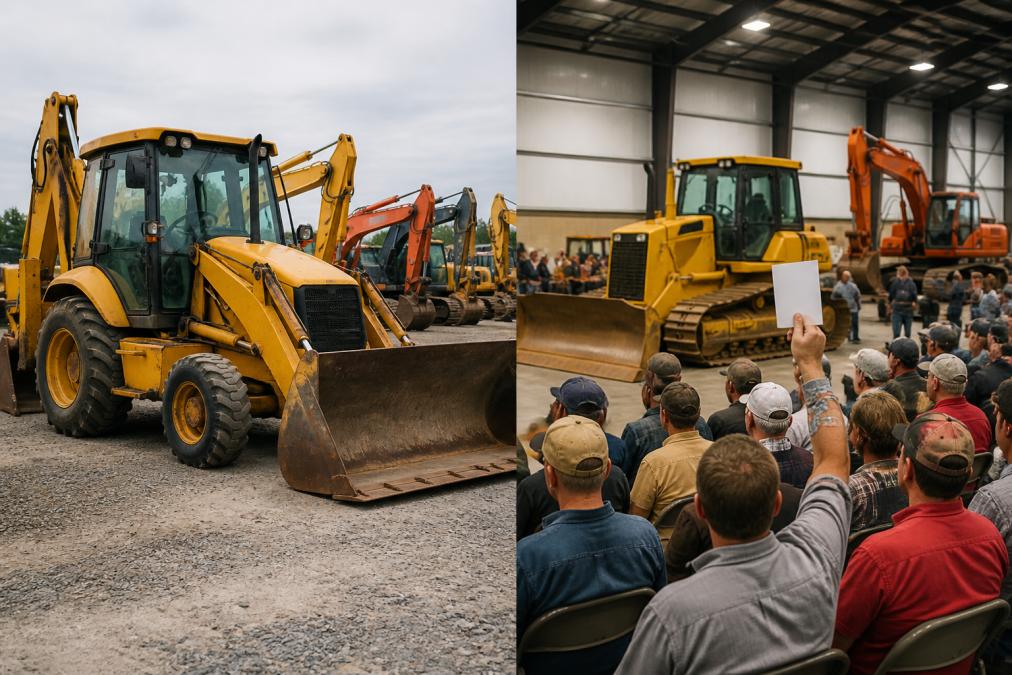
 comparison
Online Marketplace vs Local Auction for Machinery
Table of Contents
- Online Marketplace vs Local Auction for Machinery: Key Differences
- Comparison Table: Online Marketplace vs Local Auction
- Transaction Speed and Turnaround Time
- Used Machinery Sales Commission Rates and Fee Structures
- Control Over Pricing and Price Discovery
- How to Finance Used Heavy Equipment After Purchase
- Heavy Equipment Appraisal Methods and Inspection Standards
- Geographic Reach, Buyer Pool, and Inventory Availability
- Frequently Asked Questions
Last Updated: September 21, 2026
Online Marketplace vs Local Auction for Machinery: Key Differences
The choice between an online marketplace and a local auction shapes inventory speed, fees, and price control. The differences matter far more than most realize.
An online marketplace vs local auction for machinery represents two fundamentally different approaches. Online marketplaces like Equipment Trader offer fixed-price listings where you set terms. Local auctions create urgency through competitive bidding. Choose based on whether you're optimizing for price certainty, speed, geographic reach, or inventory turnover.
The real cost isn't just commission, it's total cost of ownership: capital holding time, inspection access, and negotiation control. This article will break down the hidden trade-offs.
Comparison Table: Online Marketplace vs Local Auction

| Factor | Online Marketplace | Local Auction | Winner |
|---|---|---|---|
| Price Control | You set fixed price; negotiate individually | Competitive bidding; no reserve on some platforms | Marketplace |
| Sales Speed | Slower (days to weeks) | Fast (weekly cycles, same-day liquidation) | Auction |
| Geographic Reach | National/multi-regional | Local/regional only | Marketplace |
| Buyer Pool Size | Larger, more diverse | Smaller, local-focused | Marketplace |
| Commission Rates | Contact for pricing (typically 5-15%) | Contact for pricing (typically 10-20%) | Marketplace |
| Equipment Inspection | Photos/descriptions; remote negotiation | In-person viewing encouraged | Auction |
| Capital Recovery Time | Longer holding period | Fast turnover | Auction |
| Price Volatility | Predictable, negotiated | Unpredictable, bid-driven | Marketplace |
| Best For | High-value items; negotiation-friendly sales | Fast liquidation; bulk inventory | , |
Transaction Speed and Turnaround Time
Local auctions win on speed. A weekly cycle means equipment sells within 7 days. Platforms like AuctionTime and BigIron operate on predictable schedules. This matters for quick cash conversion or yard clearance.
Online marketplaces take longer, fixed-price listings sit 2-4 weeks before attracting serious buyers. That's capital tied up in depreciating assets, costing contractors real money in seasonal cash flow.
Trade-off: faster auction sales often mean lower prices if the buyer pool is thin. Online marketplaces let you hold for target price, but you hold longer.
Used Machinery Sales Commission Rates and Fee Structures
Commission structures vary significantly, and layered fees determine net proceeds more than headline rates.
Local Auction Fee Breakdown
Local auction houses charge multiple compounding fees: seller's commission, buyer's premium, listing fees, inspection fees, payment processing, and reserve fees.
Example: For a $50,000 excavator, various fees can significantly impact the net proceeds. The gap between the final price and what you net is the true auction cost.
Online Marketplace Fee Structures
Online marketplaces charge: subscription, per-listing fees, payment processing, and optional promoted listings or inspections.
Example: For a $50,000 excavator on an online marketplace, various fees can impact the net proceeds. The marketplace can offer significant savings versus auction.
The Hidden Cost: Capital Holding Period
Equipment sitting for an extended period depreciates monthly plus storage and insurance costs. Auctions selling quickly can eliminate holding costs, potentially offsetting higher commissions.
Watch for: buyer's premium not disclosed, "contact for pricing" commissions, automatic renewal fees, and payment hold periods (auctions 7-14 days; marketplaces 3-5 days).
Calculate net proceeds: Sale Price − All Fees − Holding Costs − Shipping. For a $50,000 excavator, the net proceeds can vary significantly between auction and marketplace, with the marketplace often offering better net returns due to lower fees and faster sales, unless local pickup simplifies auction logistics.
Control Over Pricing and Price Discovery
This is where online marketplaces and local auctions diverge most sharply.
On online marketplaces, you control price and negotiate directly. You retain full negotiating power and can adjust pricing based on market conditions. This suits high-value, specialized equipment where price discovery matters.
Local auctions eliminate price control. You set a reserve (if allowed), then the market decides. Competitive bidding can spike prices or stall if the buyer pool is weak. BigIron's unreserved format guarantees sale to highest bidder.
Auction dynamics create urgency and competition, but prices can crater if competition is thin. Online fixed-price listings feel slower but offer certainty, you negotiate with buyers already interested.
How to Finance Used Heavy Equipment After Purchase
Once you've bought equipment through either channel, financing becomes the next critical decision.
Traditional lenders can take an extended period with extensive appraisals. Equipment Finance Academy offers same-day funding on qualified purchases, critical since most sales require payment within 7-10 days.
Online marketplaces like Equipment Trader integrate financing before purchase. Auction platforms typically require payment at close, though some offer post-sale financing partnerships.
Fast financing lets you bid aggressively at auction or negotiate better marketplace terms as a cash-ready buyer.
Heavy Equipment Appraisal Methods and Inspection Standards
Auction House Inspection Models
Local auction platforms use two primary inspection approaches:
Model 1: Professional Third-Party Inspection, Platforms like Purple Wave conduct certified evaluations including visual assessment, operational testing, hour verification, and condition reports (A-D codes). Cost: $75-$200 to seller, included in buyer's premium. Advantage: standardized documentation reduces disputes. Disadvantage: single inspection on platform's schedule; remote bidders rely on others' assessment.
The "As-Is" Legal Standard
- The seller makes no representations about condition, function, or title clarity
- You cannot return equipment after purchase if it doesn't match the description
- If the engine fails the day after you buy it, that's your loss
- The auction house is not liable for misrepresentation unless fraud is proven (intentional deception, not just optimistic descriptions)
Online Marketplace Inspection Standards
Online marketplaces operate under different legal frameworks:
Seller-Provided Descriptions, Platforms like Equipment Trader require sellers to disclose known defects and allow buyer requests for additional photos. Sellers are liable for material misrepresentation; platforms are not. Advantage: you can negotiate inspection contingencies ("sale contingent on in-person inspection within 48 hours"). Disadvantage: dependent on seller honesty and photography quality.
Third-Party Inspection Services
For high-value equipment ($25,000+), both channels support third-party inspections:
- Equipment-specific inspectors: Certified technicians who specialize in excavators, dozers, loaders, etc. Cost: $300-$800 per inspection. They provide detailed reports on mechanical condition, wear patterns, and remaining useful life.
- Pre-purchase inspection companies: Services like Caterpillar's certified inspection program or independent shops. Cost: $200-$600. They verify hour meters, service records, and operational status.
- Auction platform inspections: As noted above, some platforms include this. Cost: Built into buyer's premium or seller's fee.
Condition Code Standards
Reputable platforms use standardized condition codes:
| Code | Definition | Typical Use |
|---|---|---|
| A | Excellent; minimal wear; full service records | Late-model equipment, low hours, well-maintained |
| B | Good; normal wear; serviceable; may need minor repairs | Mid-life equipment, average hours, regular maintenance |
| C | Fair; visible wear; functional but may need repairs soon | Older equipment, higher hours, deferred maintenance |
| D | Poor; significant wear; major repairs needed; not recommended for critical use | End-of-life equipment, very high hours, heavy use |
Risk Mitigation: Inspection Checklist
Regardless of channel, verify these items before committing:
- Hour meter and service records: Cross-reference hours against maintenance intervals. A 5,000-hour excavator with no service records is a risk.
- Fluid condition: Check engine oil, hydraulic fluid, and coolant. Dark, burnt-smelling fluid indicates deferred maintenance or overheating.
- Structural integrity: Look for cracks in the frame, boom, or bucket. Welded repairs indicate previous damage.
- Hydraulic function: Operate all controls. Slow response, jerky movement, or leaks indicate seal failure or pump wear.
- Undercarriage condition (for tracked equipment): Check track tension, sprocket wear, and idler condition. Replacement costs $5,000-$15,000.
- Title and lien status: Verify the seller has clear title and no outstanding liens. Use the National Motor Vehicle Title Information System (NMVTIS) for titled equipment.
Geographic Reach, Buyer Pool, and Inventory Availability
Online marketplaces have a massive advantage here: they reach national and multi-regional audiences.
Frequently Asked Questions
What are the main differences between selling on an online marketplace versus a local auction?
Online marketplaces offer fixed-price listings with more control over pricing and longer sales timelines, while local auctions create urgency through bidding wars and typically sell faster. Online marketplaces give you geographic reach to national buyers; local auctions limit your pool but make logistics easier. Auction sites charge commission fees (typically 10-20%), while marketplace platforms may charge subscription or listing fees. The choice depends on whether you prioritize speed, price control, or reaching a broader buyer pool.
How do used machinery sales commission rates compare between platforms?
Most online auction platforms charge commission-based fees, though exact rates depend on the platform and equipment category. Fixed-price marketplaces often use subscription or per-listing models instead of commission. Before committing to any platform, request current pricing directly, rates vary significantly. Factor total fees into your cost analysis when deciding between channels, as commission rates directly impact your capital recovery from the sale.
How long does it typically take to sell equipment on each channel?
Online auctions typically sell within 1-3 weeks due to scheduled bidding cycles and the urgency they create. Fixed-price marketplaces usually take 4-8 weeks or longer, depending on equipment type and regional demand. Local auctions may sell within days if held frequently. Your cash flow needs should guide this decision, if you need rapid liquidation, auctions create faster turnaround; if you can wait, marketplaces give you better price control and reach.
What inspection and verification standards should I expect?
Reputable platforms require detailed equipment descriptions, high-resolution photos, and often third-party inspection reports. Some platforms handle on-site photography and description writing themselves. Always verify that listings include as-is condition disclosures and that buyers can request pre-purchase inspections. Transparent inspection standards protect both you and buyers, reduce disputes, and build trust in the transaction. Check each platform's specific inspection requirements before listing.