 ultimate-guide
What Happens If You Buy a Stolen Excavator
Table of Contents
- Understanding Possession of Stolen Heavy Equipment
- Criminal Charges vs. Civil Liability When You Buy a Stolen Excavator
- How to Check Equipment Serial Numbers and Verify Ownership
- Conducting a Heavy Equipment Title Search Before Purchase
- Legal Consequences of Possessing Stolen Property
- Steps to Take If You Discover Equipment Is Stolen
- Protecting Yourself: Due Diligence and Red Flags in Private Sales
- Frequently Asked Questions
Last Updated: September 26, 2026
Understanding Possession of Stolen Heavy Equipment
Buying heavy equipment is a significant investment for construction companies, logistics firms, and manufacturers. Possession of a stolen excavator carries serious legal and financial consequences that extend far beyond losing your money.
The core issue is straightforward: if you purchase stolen equipment, you don't own it, regardless of the price you paid or the good faith of your purchase. Law enforcement and the original owner have the right to recover the machinery, leaving you without both the equipment and your investment. Understanding this risk before you buy is essential.
This guide explains what happens when equipment turns out to be stolen, how to protect yourself during purchase, and what steps to take if you discover you've bought stolen machinery.
Criminal Charges vs. Civil Liability When You Buy a Stolen Excavator
Legal consequences split into criminal and civil liability, each with different penalties and rules of evidence.
Criminal liability applies when you knowingly purchase stolen property. Possession of stolen goods is a felony in most jurisdictions when the value exceeds $1,000. If prosecutors prove you knew or should have known the equipment was stolen, you face imprisonment, fines, and a criminal record. Willful ignorance (buying without verifying ownership) can count against you.
Civil liability doesn't require criminal intent. The original owner can sue you in civil court to recover the equipment or its value, even if you purchased in good faith. You could lose a civil lawsuit and owe restitution even if you're never charged criminally.
Criminal and civil proceedings can happen simultaneously, and the equipment may be seized as evidence, leaving you without access while legal proceedings unfold.
How to Check Equipment Serial Numbers and Verify Ownership
Thorough verification before purchase is your best defense. Every piece of heavy equipment carries identifying markers that can be cross-referenced against theft databases and ownership records.
Serial numbers and PIN verification is your first line of defense. Request the serial number from the seller and verify it against the manufacturer's records and the National Insurance Crime Bureau (NICB) database, which maintains records of reported stolen equipment.
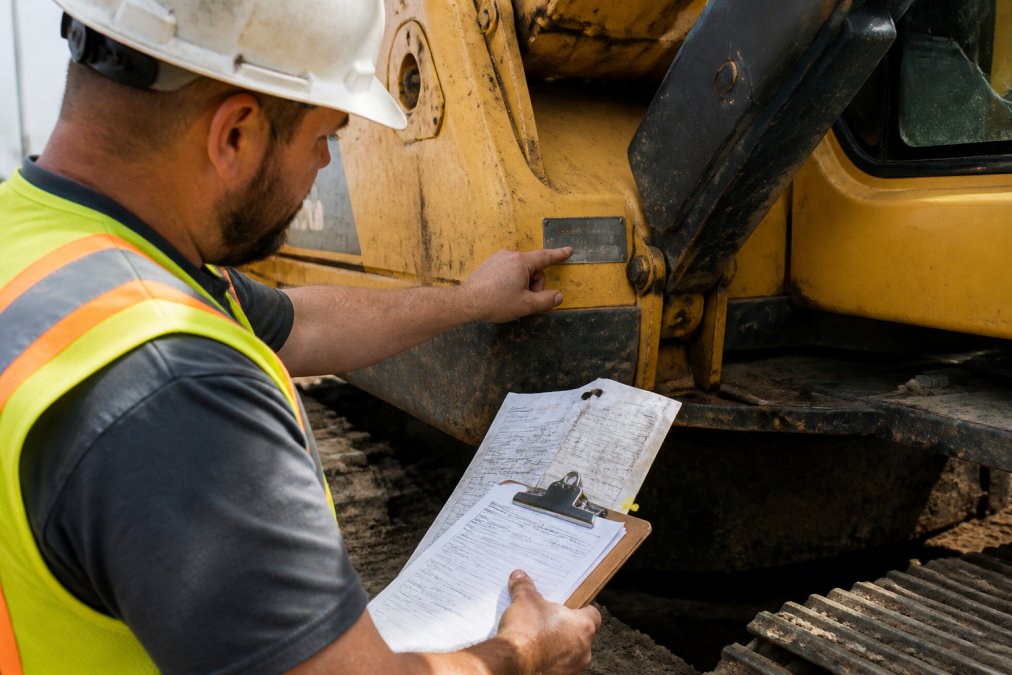
Bill of sale requirements vary by state, but most require documented transfer of ownership. A legitimate seller should provide a bill of sale with the equipment's description, serial number, purchase price, and both parties' signatures. If the seller refuses or becomes evasive, that's a red flag.
Title transfer documentation is equally important. Request proof that the seller holds clear title and that no liens exist. Title searches through state motor vehicle departments or equipment registries reveal whether the machinery is encumbered or has a disputed ownership history.
Red flags include sellers who won't provide documentation, offer prices significantly below market value, claim they've lost paperwork, or resist independent inspections.
Conducting a Heavy Equipment Title Search Before Purchase
A heavy equipment title search confirms the seller owns the equipment and no other party has a claim against it. Confirm ownership before money changes hands.
Start with the manufacturer's records. Contact the equipment manufacturer directly with the serial number to confirm the original owner and whether the equipment has been reported stolen.
Check state equipment registries. Contact your state's Department of Motor Vehicles to search for title records. A UCC search reveals whether the equipment is pledged as collateral or has outstanding claims against it.
Search the NICB database. The NICB maintains a database of reported stolen heavy equipment. If the serial number appears, walk away immediately, the equipment is flagged as stolen property.
Hire a third-party inspection service. For high-value equipment purchases, professional inspection and title verification services provide documentation of your due diligence, strengthening your legal position if a problem emerges.
Legal Consequences of Possessing Stolen Property
If you purchase a stolen excavator and law enforcement discovers it, the consequences unfold in stages. First comes the seizure: police or federal agents will impound the equipment as evidence in a theft investigation. You lose access to it immediately, even before any charges are filed.
Criminal prosecution follows if evidence suggests you knew or should have known the equipment was stolen. Possession of stolen property charges can be filed as a misdemeanor (for lower-value equipment) or a felony (for heavy machinery typically valued above $1,000). Felony convictions carry potential prison sentences and significant fines, depending on the state and the equipment's value.
Civil restitution is separate from criminal penalties. The original owner can sue you for the equipment's market value at the time of theft, plus interest and legal costs. Even if criminal charges are dropped or you're acquitted, you can still lose a civil case and owe substantial damages. The original owner's insurance company may also pursue recovery from you if they paid a theft claim.
Asset seizure and forfeiture may occur under state or federal asset forfeiture laws. Authorities can seize the equipment as proceeds of a crime, meaning you lose it permanently without compensation, even if you're never convicted.
Collateral business damage extends beyond the immediate legal consequences. A criminal record affects your ability to obtain financing for future equipment purchases, secure bonding for construction contracts, or maintain professional licenses in some fields. A criminal record affects your ability to obtain financing for future equipment purchases, secure bonding for construction contracts, or maintain professional licenses in some fields. A theft-related conviction significantly impacts your eligibility for financing.
Steps to Take If You Discover Equipment Is Stolen
If you discover after purchase that your excavator or other equipment is stolen, immediate action is critical. Delay increases your legal exposure and complicates recovery options.
Step 1: Stop using the equipment immediately. Continued operation after discovering theft strengthens arguments that you acted with knowledge of the theft. Cease all use and document when you stopped.
Step 2: Contact law enforcement. File a report with local police or the FBI if federal jurisdiction applies. Provide all documentation: the bill of sale, proof of purchase, verification steps you took, and the discovery that led you to realize the equipment was stolen. This report creates an official record of your good faith purchase and subsequent discovery, which is crucial for your legal defense.
Step 3: Preserve all documentation. Gather every piece of paper related to the purchase: the bill of sale, wire transfer receipts, communications with the seller, inspection reports, verification searches you conducted, and any correspondence with law enforcement. This documentation demonstrates your due diligence and good faith, which can mitigate criminal liability and support a civil defense.
Step 4: Notify the seller in writing. Send a formal letter (certified mail) to the seller stating that the equipment is stolen and demanding restitution.
Protecting Yourself: Due Diligence and Red Flags in Private Sales
The most effective protection is thorough due diligence before purchase. Private sales of heavy equipment carry higher risk than dealer purchases because there's no intermediary vetting the seller or the equipment's history.
Red flags that demand caution:
- Seller refuses to provide a bill of sale or claims it's lost
- Price is significantly below market value (10-20% or more)
- Seller pressures you to complete the purchase quickly without verification
- Serial numbers are missing, altered, or don't match documentation
- Equipment has no title or the title is in someone else's name
- Seller cannot provide proof of ownership or financing history
- Equipment is being sold by someone other than the registered owner without power of attorney
- Communication is primarily through cash offers or untraceable payment methods
- Seller avoids in-person meetings or inspection requests
Verification steps before purchase:
- Obtain the serial number and verify it against manufacturer records
- Conduct a UCC filing search in the state where the equipment is located
- Search the NICB stolen equipment database
- Request a bill of sale with full equipment description and both parties' identification
- Verify the seller's identity and ownership through state title records
- Hire a professional inspection service for equipment valued above $50,000
- Check for outstanding liens through your state's equipment registry
- Request maintenance records and service history as proof of legitimate ownership
- Never pay before all verification is complete
- Document all verification steps and keep copies of every record
Payment and title transfer best practices:
Frequently Asked Questions
What happens if you unknowingly buy a stolen excavator?
If you purchase a stolen excavator in good faith, you may still face legal consequences. The original owner can file a civil claim to recover the equipment, and law enforcement may seize it during an investigation. You could lose both the excavator and your money. To protect yourself, always verify the equipment's title, serial number, and ownership history before completing any purchase from a private seller or dealer.
How do you check if an excavator has been reported stolen?
Request a VIN/PIN verification report from the equipment manufacturer or a title search service. Many heavy equipment dealers can run these checks. Ask the seller for proof of purchase, bill of sale, and title documentation. If the seller refuses or provides incomplete documentation, that's a major red flag indicating potential theft or fraudulent transaction.
Are you legally liable if you purchase stolen heavy equipment?
Yes. Even a good faith purchase does not protect you from civil liability. The original owner retains ownership rights and can recover the equipment through court action. In some cases, you may also face criminal charges for unlawful possession of stolen property, depending on whether law enforcement determines you knew or should have known the equipment was stolen. Conduct thorough due diligence before any purchase.
Can you get your money back if you buy stolen machinery?
Recovery is difficult and uncertain. If you can prove you purchased in good faith without knowledge of theft, you may have grounds for a civil claim against the seller for fraud or breach of warranty. However, the seller may be judgment-proof or untraceable. Law enforcement will not compensate you; their role is criminal investigation and asset recovery for the original owner. Verify ownership and title before purchase to avoid this situation entirely.