 how-to
How Do You Inspect Crane Hydraulic Systems?
Last Updated: October 30, 2026
Quick Summary
A crane hydraulic inspection checks fluid, hoses, cylinders, valves, and controls, starting with the crane shut down and pressure released before any functional test. Run the checks in a fixed order: secure the machine, walk the perimeter, check leaks before fluid level, then hoses, cylinders, valves, and a test run.
- Secure the crane on level ground with chocks set, boom or load lowered, and engine off before inspecting.
- Check for leaks and seepage before the oil level so a low reading tells you fluid is being lost.
- Never use your hand to find a pinhole leak on a live line; use cardboard or paper instead.
- A cylinder that drifts under load is a remove-from-service item until repaired and retested.
- Log date, machine hours, inspector, defect, severity, corrective action, and retest result for every finding.
Table of Contents
- What a Crane Hydraulic Inspection Covers Before You Start
- Your Crane Hydraulic System Inspection Checklist
- Crane Hydraulic Hose Inspection: Fittings, Cracks, and Injection Safety
- Crane Hydraulic Cylinder Inspection: Scoring, Wear, and Deformation
- Crane Hydraulic Fluid Inspection: Condition and Contamination
- Pressure and Performance Diagnostics During a Test Run
- When to Remove a Crane From Service and How to Record It
- Funding a Replacement Crane When Repairs No Longer Pay
- Frequently Asked Questions
What a Crane Hydraulic Inspection Covers Before You Start
A crane hydraulic inspection is a structured check of the fluid, hoses, cylinders, valves, and controls that move a crane's load safely.
Here is the core rule. Inspect with the crane shut down and the pressure released first, then run a functional test.
Before you touch anything, confirm four things:
- The crane is on level ground with wheel chocks in place.
- The boom or load is fully lowered and secured.
- The engine is off and the key is controlled by you.
A common mistake is starting with the oil level. Check for leaks and damage first, because a low reading tells you nothing until you know whether the fluid leaked out.
Your Crane Hydraulic System Inspection Checklist
A crane hydraulic system inspection checklist is most reliable when run in a fixed order: secure the machine, walk the perimeter, check fluid and leaks, then valves, hoses, cylinders, and a functional test.
The order matters: release stored pressure and lower the load before touching any component, and check for leaks before the oil level so a low reading tells you whether fluid is being lost slowly or suddenly.
Here is a common working order, with pass/fail criteria that separate a thorough inspection from a glance:
| Step | What You Check | Pass Criteria | Time | Frequency |
|---|---|---|---|---|
| 1 | Secure and isolate | Crane on level ground, chocks set, boom/load lowered, engine off, key controlled | 2 min | Every shift |
| 2 | Visual walkaround | No missing parts, loose bolts, cracked mounts, missing decals | 5-10 min | Every shift |
| 3 | Leaks and seepage | No drips, no damp patches at fittings, no pooling on rods | 5 min | Every shift |
| 4 | Fluid level | Between add and full marks at the manual's specified temperature | 2 min | Every shift |
| 5 | Hoses and fittings | No cracks, bulges, chafing, corrosion, or weeping | 10 min | Every shift |
| 6 | Cylinders and rods | No scoring, dents, seal leakage, or drift under load | 5 min | Every shift |
| 7 | Valves and controls | Smooth response, returns to neutral, no sticking spools | 5 min | Every shift |
| 8 | Fluid condition | Clear amber color, no water, grit, metal, or foam | 10 min | Weekly |
| 9 | Pressure and function test | Functions meet manual specs, no drift, no overheating | 15 min | Weekly or after repair |
Keep this list with the machine, since a written record is more dependable than memory.
Pre-Operation Visual Walkaround
Start at the ground and work up. Look for missing parts, loose bolts, and cracked mounts before you climb.
Walk the full perimeter. Check outriggers, pads, and structural components for cracks or deformation, and verify safety decals and lever identification tags are present and readable, OSHA 1910.180 and the manufacturer's load chart depend on those markings being legible.
Then check the mechanical side: wire rope, rope spooling, brakes, and the load chart in the cab. These are not hydraulic parts, but a hydraulic fault plus a worn rope is a far more dangerous combination.
Fluid Level, Leaks, and Seepage Checks
Check the hydraulic oil level with the machine level and the fluid at the temperature the manual specifies.
Look closely for leaks and oil seepage at every connection. Fresh oil attracts dust, so a damp, dirty patch around a fitting is often the first clue.
Watch for these signs:
- Dripping fluid under the chassis
- Dark, wet patches on hoses
- Fluid pooling on the cylinder rod
Frequent top-ups mean fluid is going somewhere. Find it before it becomes a failure, a slow weep at a fitting often only shows under pressure, which is why the functional test matters.
Valves, Controls, and Functional Test
Engage each control slowly and verify the crane responds smoothly. Jerky motion, drift, or a slow function points to a valve or control problem.
Test one motion at a time: hoist, lower, boom up, boom down, swing, and telescope. Listen for unusual noise. Feel for vibration through the lever.
Run the functional test with no load first, then a light load if the manual allows.
Inspection Frequency: Pre-Use, Periodic, and Post-Repair
Not every check belongs on the same schedule. Inspections are often separated into three tiers:
- Pre-use (every shift): secure and isolate, walkaround, leaks, fluid level, hoses, cylinders, valves, functional test with no load.
- Periodic (weekly or per the manual): fluid condition sample, pressure and performance test, filter indicator check, torque check on critical fittings.
- Post-repair: full functional test under light load, pressure verification, and a written retest sign-off before the crane returns to service.
The manufacturer's manual sets the final interval. When the manual and a site rule conflict, follow the stricter one.
Recordkeeping and Defect Logging
A checklist only works if findings are written down. Keep a simple log: date, machine hours, inspector, component, defect description, severity (minor / monitor / remove-from-service), corrective action, and retest result.
Severity drives the response. A weeping fitting is a monitor item; a cracked hose or a drifting cylinder is a remove-from-service item. Logging severity separately from the description lets a shop spot a hose that keeps failing at the same fitting, a pattern memory never catches.
Crane Hydraulic Hose Inspection: Fittings, Cracks, and Injection Safety
Crane hydraulic hose inspection means checking every hose and fitting for cracks, chafing, bulges, and loose connections.
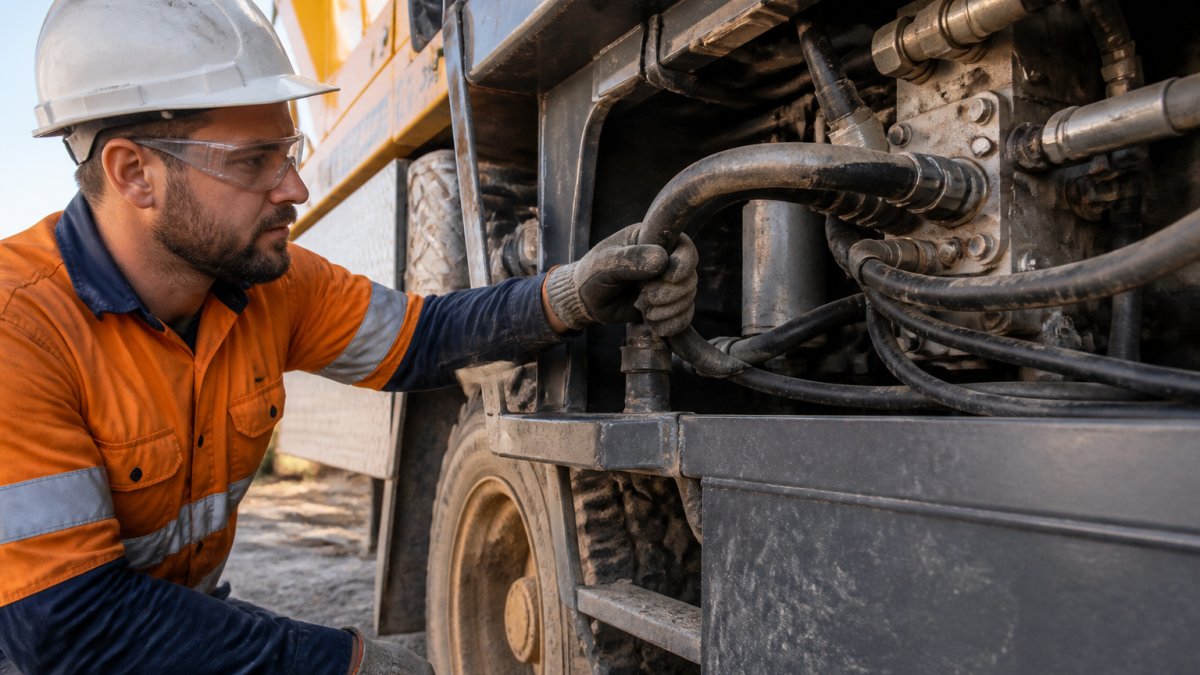
Check each hose for:
- Cracks or weather checking on the outer cover
- Bubbles or bulges that signal internal damage
- Chafing where hoses rub against the frame
Watch out: never use your hand to search for a pinhole leak on a live line. Use a piece of cardboard or paper. A fluid injection injury is a medical emergency, not a minor cut.
Replace any hose that shows cracks or bulging. Do not tape it and keep running.
Crane Hydraulic Cylinder Inspection: Scoring, Wear, and Deformation
Crane hydraulic cylinder inspection focuses on the rod, the seals, and the barrel. Scoring on a rod, meaning visible scratches or grooves, tears seals and leads to steady leakage.
Pull the cylinder out slowly and look at the exposed rod. A thin film of oil is normal. A wet, dripping rod is not. Check for:
- Scoring or scratches on the chrome
- Dents or deformation in the barrel
- Leaking at the rod seal or gland
A cylinder that drifts under load is a remove-from-service item. Drift means the load can move when it should not.
Crane Hydraulic Fluid Inspection: Condition and Contamination
Crane hydraulic fluid inspection checks color, clarity, and contamination. Dark or milky fluid, or fluid with grit in it, signals a problem inside the system.
Pull a small sample onto a clean white cloth or a clear container. Healthy fluid is clear and amber. Watch for:
- Milky or cloudy fluid, which points to water
- Dark or burnt-smelling fluid, which points to heat
- Visible grit or metal particles
Contamination wears pumps, valves, and cylinders from the inside. If you find metal particles, stop and get the system checked before the next lift, a weekly sample check catches trouble early.
Pressure and Performance Diagnostics During a Test Run
Pressure diagnostics compare a crane's actual performance against the manual's specifications, looking for slow functions, weak lifting, drift, and unusual noise under load.
What a Test Run Measures
A functional test run measures four things: speed (how fast each function moves), pressure (whether the system reaches its rated setting), temperature (whether fluid heats abnormally fast), and drift (whether a function holds position under load). You do not need a full flow bench, you need a baseline and a comparison.
Run the crane through its full range of motions with a light load. Note any function slower than normal or that stalls, listen for whining from the pump, and check for overheating lines.
Reading the Symptoms
Most hydraulic faults show up as a pattern of symptoms rather than a single failure. A common mapping practitioners use:
- Slow function under load, normal when empty: worn pump, restricted filter, or a relief valve set low.
- Pump whine that changes with demand: cavitation from low fluid, a clogged suction strainer, or air ingress.
- Fluid that gets hot fast: internal leakage past a valve or cylinder seal, or a cooler that is not working.
Using a Pressure Gauge Safely
Use a gauge only if you are trained and have the right fittings for the machine's test ports. Never crack a high-pressure connection to "see" the pressure, a pinhole stream at system pressure can inject fluid through skin.
Connect the gauge to the manufacturer's designated test port, not a random fitting. Compare the reading to the manual's specification for that function at the specified engine speed and fluid temperature.
When to Stop and Call a Technician
Stop the test run and isolate the crane if you see any of the following:
- A function that drifts under load
- Pressure that will not reach the manual's specification
- Fluid temperature climbing faster than normal
These are not "monitor" items. They are remove-from-service criteria until a qualified technician diagnoses and repairs the system and the crane passes a retest.
When to Remove a Crane From Service and How to Record It
Pull a crane from service when a hydraulic fault could affect load control. That includes drift, a leaking cylinder, a cracked hose, or any loss of a safety device.
Lock out and tag out the power sources before any repair. Record the fault, date, machine hours, and who found it, then note the repair and retest result.
Keep records for every daily inspection.
Funding a Replacement Crane When Repairs No Longer Pay
There comes a point where repair bills and downtime cost more than a replacement.
Equipment Finance Academy connects you with equipment lenders through a financing marketplace. You can access equipment financing options and see what fits your budget.
If repair costs are stalling your projects, you can explore financing options through Equipment Finance Academy to help put a replacement machine back on the job.
Frequently Asked Questions
How often should a crane hydraulic inspection be done?
Run a visual and functional crane hydraulic inspection before every shift, and have a qualified technician do a deeper hydraulic check at the manufacturer's recommended service intervals. Any crane that has sat idle, been transported, or worked in wet or dusty conditions should get a full walkaround before it lifts again. Log every inspection with the date, findings, and the name of the person who signed off, so you can show a maintenance history if a defect is questioned later.
What are the signs of a failing crane hydraulic pump?
Watch for slow or jerky crane motions, weak lifting under load, whining or knocking from the pump, fluid that foams or overheats, and metal particles in the hydraulic oil. Any of these point to wear inside the pump or a restriction upstream. Stop operating and have the system pressure-tested rather than topping off fluid and continuing. A pump that fails under load can drop a boom without warning.
What should you do if you find a hydraulic defect during an inspection?
Tag the crane out of service, lock out the power source, and record the defect in writing before anyone else uses the machine. Do not attempt a field repair on a pressurized hydraulic line, and never use your hand to check for a pinhole leak; use a piece of cardboard or paper. Escalate to a qualified hydraulic technician, and only return the crane to service after the repair is verified and the inspection record is updated.
Can a crane hydraulic hose be repaired, or does it need replacing?
Replace it. A hose with cracks, bulges, abrasion through the outer cover, or a weeping fitting is a failure waiting to happen, and patch repairs do not hold under crane pressure. Match the replacement to the original pressure rating, size, and routing, and check that it clears hot surfaces and sharp edges. After replacement, cycle the function through a full range and recheck every fitting for seepage before the crane goes back to work.