 how-to
How to Compare Heavy Equipment Loan Interest Rates
Table of Contents
- Understand What You're Actually Comparing
- Current Equipment Financing Rate Ranges by Credit Profile
- How Equipment Loan Fees Affect Your True Cost
- Step-by-Step Method for Comparing Loan Offers
- Using a Heavy Equipment Loan Calculator to Compare Scenarios
- Used Equipment Financing Rates vs. New Equipment
- Negotiation Tactics and Rate-Shopping Best Practices
- Common Mistakes to Avoid When Comparing Equipment Loans
- Frequently Asked Questions
Last Updated: October 13, 2026
Understand What You're Actually Comparing
When shopping for heavy equipment financing, the advertised interest rate is rarely the full story. Most borrowers focus only on the percentage, then get surprised by fees and payment structures that change the actual cost. Understanding what you're comparing is the first step to a real deal.
The gap between a simple interest rate and the true cost of borrowing can swing your monthly payment by hundreds of dollars. That's why learning how to compare heavy equipment loan interest rates matters. Equipment Finance Academy helps business owners see what they're actually paying.
Interest Rate vs. APR: Why the Difference Matters
Interest rate is the percentage you pay on the borrowed amount. APR (Annual Percentage Rate) includes the interest rate PLUS fees, spread across the loan term as an annual figure. This is the number that tells you the true yearly cost.
A lender might quote 7% interest, but with origination and documentation fees, the APR could be 8.5%. Two lenders may quote similar rates, yet different fee structures mean one has a much higher APR. Always ask for the APR in writing, it's the only fair way to compare.
The Real Cost: Total Interest and Fees
Total interest is what you pay in interest dollars over the loan's life; total cost of borrowing adds all fees. A $100,000 loan at 7% over five years costs roughly $19,000 in interest; add a $2,000 origination fee and total borrowing costs hit $21,000, 21% of the original amount. Many borrowers focus only on monthly payment, but a lower payment often means a longer term and more total interest. The monthly number looks good; the total cost hurts your bottom line.
Current Equipment Financing Rate Ranges by Credit Profile
Lenders adjust rates based on your credit profile: well-qualified borrowers get better rates, while newer or credit-challenged businesses pay more. These are broad ranges; your actual rate depends on loan amount, equipment type, down payment, and business financials. Alternative lenders often charge more but approve faster with looser credit requirements. The gap between excellent and fair credit can be significant, so if your credit is below 700, improving it before you apply can save thousands in interest.
How Equipment Loan Fees Affect Your True Cost
Fees are where lenders make money beyond the interest rate, and most borrowers never add them up. Common fees include origination (1-3% of loan amount), documentation, appraisal, title search, and prepayment penalties; some lenders roll everything into the loan so you don't see the impact until you calculate total cost. A $50,000 loan with a 2% origination fee costs $1,000, which gets financed, over five years, that fee becomes $1,200+ with interest.
Common Fees to Watch For
Origination fee: 1-3% of loan amount, the lender's processing and underwriting cost, often the largest fee.
Documentation fee: $200-$500 for paperwork, filing, and administration.
Appraisal fee: $300-$1,000 to verify equipment value.
Title search and recording: $100-$300 to confirm ownership and file the lien.
Prepayment penalty: Some lenders charge if you pay off early. Read the terms; you want the right to prepay without penalty.
Application fee: $0-$500. Always ask if it's refundable if you're denied.
Calculating Total Cost With Fees Included
To see the real number, take your loan amount, add all fees, then calculate interest on that total.
Example: You need $75,000 for equipment.
- Loan amount: $75,000
- Origination fee (2%): $1,500
- Documentation fee: $300
- Appraisal fee: $500
- Total financed: $77,300
- Interest at 8% over 60 months: $17,200
- Total cost of borrowing: $19,200
That $19,200 is 25% of the original equipment cost, the real price of financing. Many borrowers see only the $75,000 and the 8% rate, then get shocked by the monthly payment.
Step-by-Step Method for Comparing Loan Offers
Don't compare offers on interest rate alone. Use this method to see what you're actually paying.
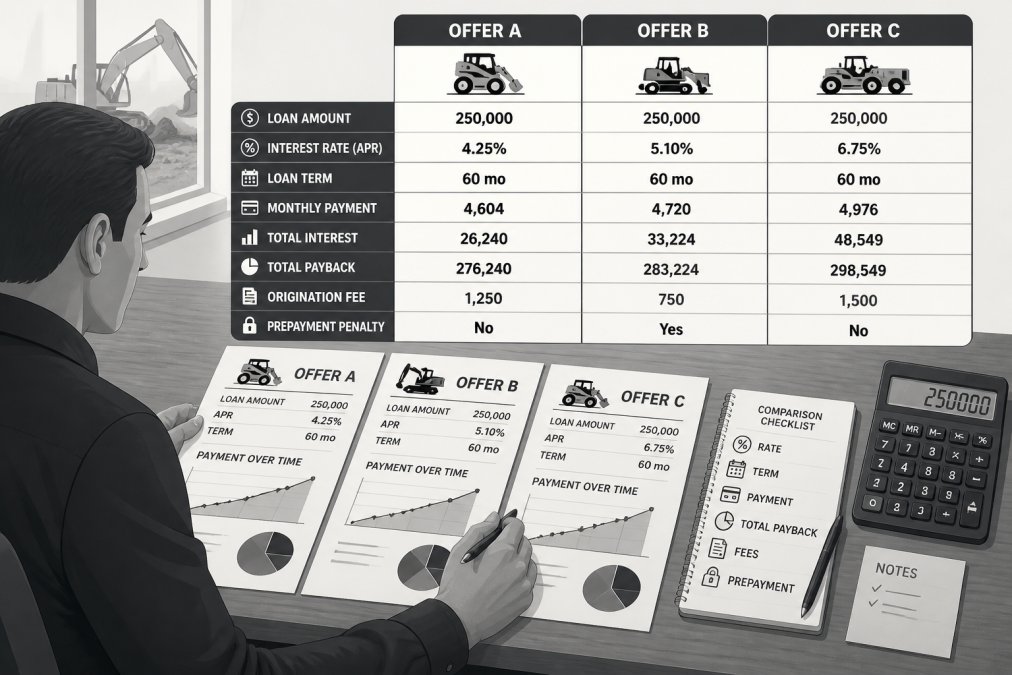
Step 1: Standardize the Loan Amount and Term
All quotes must use the same loan amount and repayment period, a $75,000 loan over 60 months, not 48 months from one lender and 72 from another. Tell each lender: "I need $75,000 for equipment financing. I want a five-year term. Give me your best rate and fees for that scenario." Different terms hide real cost differences: longer terms lower monthly payment but increase total interest. Keep the term constant so you can compare.
Step 2: Request Full Disclosure of APR and All Fees
Don't settle for a rate quote. Demand a Loan Estimate that shows APR and itemizes every fee.
Ask for:
- Interest rate (the percentage)
- APR (the true annual cost)
- Origination fee (dollar amount)
- All other fees (list each one)
- Monthly payment amount
- Total interest over the life of the loan
- Total cost of borrowing (principal + interest + fees)
A good lender provides this in writing without asking twice. If a lender is vague about fees or won't put numbers on paper, move on.
Step 3: Calculate Total Interest and Total Cost of Borrowing
Take the APR and loan amount, calculate what you'll pay in interest dollars, then add fees for total cost. Use a basic loan calculator or spreadsheet: multiply the monthly payment by the number of months, subtract the principal for total interest, then add fees.
Example: $75,000 at 8% APR over 60 months.
- Monthly payment: $1,520
- Total paid: $1,520 × 60 = $91,200
- Interest paid: $91,200 - $75,000 = $16,200
- Add fees ($2,300): Total cost = $18,500
That $18,500 is what the loan actually costs. Compare this number across all offers, not the interest rate.
Step 4: Compare Monthly Payment Impact
Monthly payment matters because it affects cash flow, but don't sacrifice total cost for a lower payment. A 72-month term looks better monthly than a 60-month term, yet you pay thousands more in total interest. If you're tight on cash, a lower payment helps, just know the trade-off.
Compare all four numbers side by side: APR, monthly payment, total interest, and total cost. One offer might have the lowest rate but highest fees; another a higher rate but lower fees. The one with the lowest total cost is your best deal.
Using a Heavy Equipment Loan Calculator to Compare Scenarios
A heavy equipment loan calculator lets you test scenarios quickly, change the loan amount, term, or rate and see the effect on monthly payment and total cost. Most online calculators are free and show results instantly.
But don't rely on calculators alone. They show the math, not actual lender offers. Use one to understand the relationships between rate, term, and cost, then use real lender quotes to decide.
Used Equipment Financing Rates vs. New Equipment
Lenders treat used and new equipment differently: new equipment holds value better and is easier to repossess, while used equipment is riskier. Expect to pay 1-3 percentage points more for used equipment financing, a new excavator might finance at 7%, the same model used at 9-10%.
Why Used Equipment Often Costs More to Finance
Used equipment depreciates faster, so if you default and the lender repossesses, they recover less than on new equipment. Used machines also have unknown maintenance history, while new ones come with a warranty. Lenders price this risk into the rate.
Loan-to-Value Ratios and Down Payment Impact
Loan-to-value (LTV) is the loan amount divided by equipment value: a $50,000 loan on a $100,000 excavator is 50% LTV; $75,000 is 75% LTV. Higher LTV means higher risk, so rates rise as LTV increases. Lenders typically finance new equipment up to 100% of value, but used equipment usually maxes out at 70-80% LTV, meaning a bigger down payment is required.
A larger down payment lowers your LTV and gets a better rate, and reduces the loan amount and monthly payment. Put 30-40% down and you'll get better terms than with 10% down.
Negotiation Tactics and Rate-Shopping Best Practices
Don't accept the first offer. Most borrowers get one quote and take it, leaving money on the table. Get at least three quotes from different lenders, compare using the method above, then use the best offer to negotiate with your preferred lender.
How to Approach Multiple Lenders Without Damaging Your Credit
Each loan application triggers a hard inquiry, and multiple inquiries hurt your score. But multiple inquiries for the same loan type within 14-45 days count as one. Shop within a two-week window so your score takes one hit, not several.
Tell lenders you're comparing offers, most expect it, and it signals you're serious and financially aware.
Use Points: What Lenders Will Move On
Lenders have flexibility on rate, fees, and terms, but won't budge on all three, they'll negotiate on at least one.
With strong credit and financials, use your leverage: "Your competitor quoted me 7.5%. Can you match that?" Many will. With weaker credit, use your down payment, a larger one reduces their risk and may earn better terms. Origination fees are often negotiable too, since lenders build in margin.
Don't negotiate everything at once. Focus on one thing: the lowest APR, a waived fee, or the longest term. Lenders respond better to focused requests than to "make me a better deal."
Common Mistakes to Avoid When Comparing Equipment Loans
Most borrowers make the same mistakes. Knowing them helps you avoid them.
Mistake 1: Comparing only the interest rate. APR, fees, and total cost matter more.
Mistake 2: Not asking about the APR. Lenders must disclose it.
Mistake 6: Not negotiating. If you don't ask, you don't get. Use competing offers as leverage.
Mistake 7: Overlooking prepayment penalties. If you plan to pay down the loan faster, avoid these.
Equipment financing is one of the biggest expenses a business takes on.
Shopping for equipment financing doesn't have to mean juggling dozens of lender calls and confusing rate quotes.
Frequently Asked Questions
Should I compare equipment loan APR or just the interest rate?
Always compare APR. The interest rate alone doesn't show the full cost. APR includes the interest rate plus fees spread across the loan term, giving you an accurate picture of what you'll actually pay. Two loans with the same interest rate can have different APRs if one charges higher origination or processing fees. When comparing heavy equipment loan interest rates, APR is the standard metric lenders must disclose, making it the fairest comparison point across different offers.
What equipment loan fees should I expect and how do they affect my total cost?
Common equipment loan fees include origination fees (typically 1-3% of the loan amount), processing fees, appraisal fees, and documentation fees. These can add hundreds or thousands to your total borrowing cost. For example, a $100,000 loan with a 2% origination fee costs $2,000 before you make a single payment. Always request a complete fee disclosure from each lender and add these to the total interest to calculate your true cost. Some lenders offer no-fee options, so compare total cost, not just the advertised rate.
How much does the loan term affect the total cost of equipment financing?
Loan term has a major impact on total cost. A longer term means lower monthly payments but significantly more total interest paid. For example, financing the same equipment over 7 years instead of 3 years can nearly double your total interest expense, even at the same interest rate. However, a longer term also preserves cash flow for operations and emergencies. When comparing offers, calculate the total interest cost for each term option, not just the monthly payment, to understand the real trade-off.
How do I know if a heavy equipment loan interest rate is competitive?
Competitive rates depend on your credit profile, the equipment type, whether it's new or used, and current market conditions. Well-qualified borrowers typically see favorable rates for traditional bank loans, while alternative lenders may quote higher rates. The best approach is to request quotes from at least three different lenders, banks, credit unions, and alternative lenders, using the same loan amount, term, and equipment details. Compare the APR and total cost across all offers rather than relying on a single quote or published benchmark.