 how-to
How to Verify Used Machinery History: A Step-by-Step Guide
Table of Contents
- Why Verifying Used Machinery History Matters
- Step 1: Request and Review Maintenance Records and Service Logs
- Step 2: Verify Operating Hours and Check for Tampered Hour Meters
- Step 3: Perform a Heavy Equipment Lien Search
- Step 4: Conduct a Physical Inspection Using a Used Machinery Inspection Checklist
- Step 5: Run a Heavy Equipment Serial Number Lookup
- Step 6: Assess Hydraulic Systems and Fluid Condition
- Red Flags That Warrant Walking Away
- Frequently Asked Questions
Last Updated: September 22, 2026
Why Verifying Used Machinery History Matters
Buying used machinery without the ability to verify used machinery history risks inheriting hidden problems that cost thousands to fix. Before securing financing, you need to know what you're actually buying.
A falsified hour meter could hide 5,000 actual hours of wear. Transmission failure, hydraulic leaks, and system breakdowns don't just cost money, they shut down job sites and damage client relationships.
Step 1: Request and Review Maintenance Records and Service Logs
Request complete maintenance records for the entire life of the machine. Good records show oil changes, hydraulic servicing, repairs, and maintenance dates. Gaps are a red flag. Look for patterns: frequent repairs to the same component suggest systemic problems; long service intervals suggest neglect. Ask if the seller has digital service logs from the manufacturer or fleet management system, these are harder to fake than paper logs.
Step 2: Verify Operating Hours and Check for Tampered Hour Meters
Hour meter readings determine equipment value and lifespan. Tampering is common, so verify readings using both physical inspection and digital forensics.
Physical Hour Meter Inspection:
Check if the meter is original or replaced (replacement is suspicious). Look for disassembly signs, scratches, mismatched fasteners, or loose wiring. Mechanical meters can be rolled back, look for tool marks or fresh fastener damage.
Compare the hour reading to engine condition. Heavy corrosion or worn belts on a low-hour machine suggest meter tampering. Cross-reference service records, fuel consumption, and maintenance intervals, all should align with the stated hour meter reading.
Digital Forensic Verification via ECU and Telematics:
Modern equipment logs operating hours in the Engine Control Unit (ECU) and telematics systems, far harder to tamper with than mechanical meters. Request ECU data and telematics access (Caterpillar VisionLink, Komatsu KOMTRAX, Volvo Dynafleet, John Deere Operations Center). Fleet management accounts can export reports showing total ECU hours, runtime summaries, idle time, location history, and fault codes.
Compare ECU hours to the mechanical meter. A discrepancy over 5-10% warrants investigation and suggests tampering or ECU replacement.
Request a diagnostic scan using a handheld code reader (Snap-on Solus Pro, Autel MaxiSys, or manufacturer tools) to pull total engine hours, fuel consumption, engine start count, and fault code history. These parameters are stored in non-volatile memory and cannot be altered. Refusal to allow a scan is a red flag.
Cross-Referencing Multiple Data Sources:
Triangulate across mechanical meter, ECU hours, telematics records, service logs, fuel consumption, and physical engine wear. If all align, you have high confidence. If two or more conflict, the true operating history is uncertain, walk away or negotiate a significant price reduction.
When to Involve a Third-Party Inspector:
For equipment over $50,000, hire an independent inspector ($300-$800) to perform diagnostic scans and ECU data pulls. This cost is negligible compared to the risk of falsified hours.
Step 3: Perform a Heavy Equipment Lien Search
Verify the seller owns the equipment free and clear. Conduct a UCC lien search through your state's Secretary of State office using the serial number and seller's name. If a lien appears, require written proof it will be satisfied at sale before taking ownership. Check if your state requires title documents and verify the seller is listed as owner with no liens noted. A clean lien search confirms the seller has the right to sell without other claims.
Step 4: Conduct a Physical Inspection Using a Used Machinery Inspection Checklist
Conduct a thorough physical inspection in person with a checklist. Pay special attention to cosmetic condition, fresh paint and new decals often mask structural problems and rust.
Red Flag: Fresh Paint and Cosmetic Refurbishment
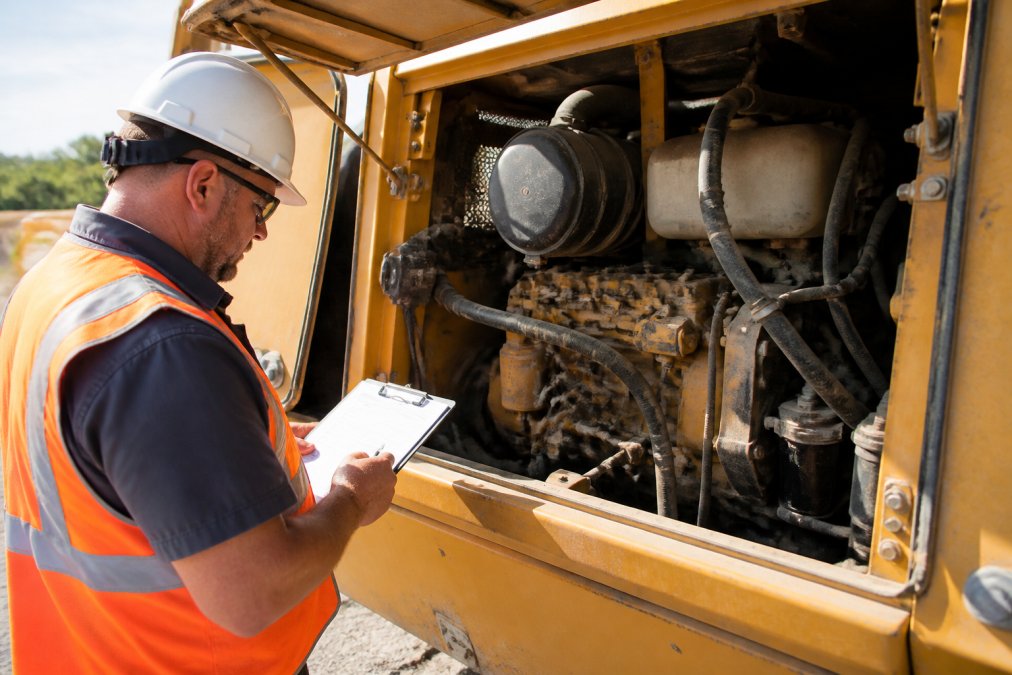
Equipment that looks too clean for its age may conceal damage. Fresh paint hides surface rust, welding repairs, stress fractures, water damage, and hydraulic leaks. Use a paint depth gauge ($20-$50), factory paint is 3-5 mils; repaints are 8-12 mils. Look for overspray on seals and hose connections (indicates rushed work). Check for paint caked in crevices (indicates rust coverage rather than proper remediation).
Inspect the undercarriage and frame for orange rust bloom, pitting, newer welding seams, and paint adhesion failures. Heavy undercarriage rust with fresh topside paint indicates hidden frame deterioration, expensive to repair and a sign of salt, moisture, or poor storage exposure.
Standard Inspection Checklist:
Engine and Cooling System: Check for oil leaks (wipe dry, run 5 minutes, check again). Listen for knocking (bearing wear), grinding (internal damage), squealing, or rattling. Watch exhaust: blue smoke = oil burning; black smoke = incomplete combustion; white smoke = coolant leak. Check coolant color (should be bright green, orange, or pink; brown indicates corrosion). Inspect belts and hoses for cracks, fraying, or hardening.
Transmission and Drivetrain: Check fluid color and smell (bright red/amber is normal; dark/burnt indicates overheating). Metallic particles indicate wear. Shift through gears, smooth engagement is normal; jerky shifts suggest worn clutches. Check for leaks at pan, seals, and output shaft. Inspect driveshaft for dents, bending, or missing balance weights.
Undercarriage and Frame: Look for cracks near welds and stress points. Inspect welds, rough, discolored, or overlapping welds suggest multiple repairs. Check for rust in corners and seams; use a wire brush to assess pitting depth. Measure frame dimensions for bending or twisting. Inspect bolts, rust-seized bolts indicate moisture exposure; missing or mismatched fasteners suggest poor maintenance.
Hydraulic Systems: Check for leaks at hose connections, cylinder seals, and pump connections. Verify fluid color (amber or light red is normal; dark/burnt indicates overheating; cloudy indicates water). Activate all functions, smooth operation is normal; jerking suggests wear. Listen for whining/squealing (pump cavitation) or grinding (component wear). For valuable equipment, request fluid analysis ($50-$150) to test for contamination, viscosity, metal particles, and water.
Tires, Tracks, or Wheels: Measure tread depth (penny test, if you see Lincoln's head, tread is below 2/32 inch). Check for uneven wear (one side = alignment issues; center = overinflation; edges = underinflation). Inspect for cracks, bulges, or sidewall damage. For tracked equipment, check tension and look for broken links. Inspect rims for dents, cracks, or corrosion.
Cab and Controls (if applicable):
- Check all gauges and warning lights. Start the engine and verify that gauges move and lights illuminate as expected.
- Test all controls: steering, throttle, brake, hydraulic levers, switches. Controls should respond smoothly without sticking or lag.
- Inspect the seat for tears, foam deterioration, or missing cushioning. A worn seat indicates heavy use.
- Check windows, mirrors, and wipers for cracks or damage. These affect operator visibility and safety.
- Look for water stains or mold inside the cab, indicating water intrusion or poor storage conditions.
Documentation During Inspection:
Take photos and video of every area you inspect. Document:
- Overall equipment condition and appearance
- Any rust, cracks, or damage
- Fluid leaks or stains
- Worn components
- Gauge readings and warning lights
- Serial number and hour meter reading
Create a written inspection report with notes on each section. This protects you if a dispute arises later and provides a baseline for negotiating price adjustments.
Step 5: Run a Heavy Equipment Serial Number Lookup
The serial number is your direct line to verify used machinery history and confirm the equipment's identity. A serial number lookup reveals the manufacturer, model year, original specifications, and sometimes ownership history.
Find the serial number on the equipment itself. It's usually stamped on the frame or engine block. Write it down exactly as it appears.
Use the manufacturer's database to look up the machine. Most equipment manufacturers maintain records of every machine they produce. You can often access this information through their website or by calling their customer service department.
The lookup will confirm the model year and original specifications. This helps you verify that the equipment hasn't been modified in unsafe ways. It also confirms the machine isn't stolen, stolen equipment won't match the seller's story about its origin.
Check the serial number against databases of salvage or rebuilt equipment. Some machines are declared total losses by insurance companies and then rebuilt. You want to know this before buying.
If the serial number doesn't match the seller's story, different year, different model, different specifications, stop the deal. Mismatched serial numbers indicate fraud.
Step 6: Assess Hydraulic Systems and Fluid Condition
Hydraulic systems are the muscle of heavy equipment. A failing hydraulic system can cost thousands to repair. Checking fluid condition and system health is critical.
Request a fluid sample from the hydraulic reservoir if possible.
Red Flags That Warrant Walking Away
Some signs mean you should stop negotiating and find different equipment. These red flags indicate serious problems or fraud.
Walk away if:
Frequently Asked Questions
What documents should I request to verify machinery service history?
Request maintenance logs, service records, oil analysis reports, warranty documentation, and any repair receipts. Ask for telematics data if the equipment has modern diagnostic systems. Legitimate sellers maintain organized records showing preventative maintenance intervals, fluid changes, component replacements, and any major repairs. Cross-reference dates on service records with operating hour logs to spot inconsistencies that might indicate tampering or neglect.
How can I tell if equipment's operating hours have been tampered with?
Compare hour meter readings against service records, telematics data, and fuel consumption logs. Equipment with suspiciously low hours relative to its age or maintenance history is a red flag. Modern machines often have ECU (engine control unit) data that records actual runtime independently of the display meter. Request a diagnostic scan to pull this data. Fresh paint or unusually clean engine compartments paired with low hours are common indicators of meter tampering.
How do I perform a lien search on heavy machinery?
Search the UCC (Uniform Commercial Code) database through your state's Secretary of State office. Most states offer online UCC search tools where you can query by equipment serial number, owner name, or equipment type. A lien indicates the equipment is financed or pledged as collateral. Verify the lien has been properly released before purchase. You can also hire a title search company specializing in equipment to conduct this search and provide a full report on ownership and lien status.
What is the most important thing to check when verifying used machinery history?
Ownership documentation and lien status are critical, a lien means someone else has a legal claim to the equipment. Pair this with maintenance records showing consistent preventative care and telematics or ECU data confirming actual operating hours. Equipment with complete service history, clear ownership, and verifiable hour logs is far less likely to have hidden damage or structural issues that will fail shortly after purchase.