 how-to
Is Buying Heavy Equipment a Good Investment?
Table of Contents
- When Buying Heavy Equipment Makes Financial Sense
- Buy or Rent Heavy Equipment: Breaking Down the Decision
- Understanding Heavy Equipment ROI and Payback Periods
- Most Profitable Heavy Equipment to Own for Contractors
- Mini Excavator Profitability: A Practical Example
- Total Cost of Ownership Beyond the Purchase Price
- Financing Your Equipment Investment and Tax Benefits
- Frequently Asked Questions
Last Updated: October 8, 2026
When Buying Heavy Equipment Makes Financial Sense
Is buying heavy equipment a good investment? It depends on one critical variable: how often you'll use it. A contractor running excavation jobs five days a week faces a different equation than one doing occasional gravel work.
The real question is whether the machine pays for itself through billable work. Most owners stumble here: they buy based on what they think they'll need, not usage projections backed by actual job pipelines.
The difference between a profitable investment and a cash drain comes down to realistic ROI modeling and honest use-rate assessment.
Buy or Rent Heavy Equipment: Breaking Down the Decision
Renting costs more per use but eliminates ownership risk. Buying costs less per use over time but requires capital and maintenance. Break-even determines which wins.
Most guides stop at a rule of thumb like "rent under 20 days, buy over 100." That shortcut ignores your actual numbers. A transparent break-even calculation is more useful.
A Simple Buy-vs-Rent Break-Even Method
Compare total rental cost against total ownership cost over the same period and use level. Break-even is the number of billable days where the two are equal.
Step 1: Estimate rental cost.
Rental cost = daily rental rate × billable days + delivery and pickup fees + fuel and operator costs you pay while renting.
Step 2: Estimate ownership cost.
Step 3: Solve for the day count where the two are equal.
That day count is your break-even utilization. Below it, renting is cheaper. Above it, owning is cheaper.
Worked Example
Assume a used mini excavator priced at $28,000, financed over 48 months at 8% interest, with a $650 monthly payment. Annual costs:
- Insurance: $1,800
- Storage: $2,400
- Fuel: $5,400 (about 1,500 operating hours at roughly 1 gallon per hour and $3.60 per gallon)
- Maintenance and repairs: $3,000
- Transport between jobs: $2,000
Annual ownership cost before resale = $650 × 12 + $1,800 + $2,400 + $5,400 + $3,000 + $2,000 = $22,400.
Now assume the same machine rents for $350 per day with a $150 delivery and pickup fee per rental. At 30 rental days, cost = 30 × $350 + 30 × $150 = $15,000. Renting wins.
At 60 days, cost = 60 × $350 + 60 × $150 = $30,000. Owning wins.
The break-even sits between those points. Solving 500 × D = $22,400 gives D ≈ 45 billable days per year.
What Changes the Break-Even
- Resale value. Strong resale lowers ownership cost and break-even; fast depreciation raises it.
- Financing terms. A lower rate or longer term cuts the monthly payment and lowers break-even utilization.
- Utilization pattern. Steady year-round use beats seasonal spikes because fixed costs spread across more billable days.
- Transport distance. Long moves add cost renters avoid because the rental yard handles delivery.
- Operator and fuel responsibility. If you pay fuel and operator costs while renting, the rental side rises and ownership looks better sooner.
When Leasing Fits Between the Two
Leasing sits between renting and buying: consistent access without tying up capital, and payments are often deductible. Lease if you need predictable access 30-100 days per year and want to preserve cash for payroll or materials. Buy if you'll exceed break-even and can fund the purchase without straining cash flow.
A Quick Decision Checklist
- Do you have a documented job pipeline supporting the break-even day count?
- Can you cover the monthly payment through a slow season without borrowing?
- Have you priced insurance, storage, and transport for your area?
- Do you have a resale or trade-in plan for when the machine ages?
- Would a lease preserve cash flow while still giving you access?
If you answer yes to the first four and no to the last, ownership is likely stronger. If not, renting or leasing keeps risk lower while you build the pipeline that justifies a purchase.
Understanding Heavy Equipment ROI and Payback Periods
Equipment ROI measures how quickly the machine generates enough revenue to cover its total cost. Payback period is the months before cumulative profit equals the initial investment.
Calculate payback like this: Divide total equipment cost by monthly net profit (revenue from jobs using that equipment minus operating costs). A $50,000 excavator generating $3,000 monthly net profit has a 16-month payback period.
The catch: this assumes consistent work. Most contractors see winter use drop 40-50%, so real payback often stretches 24-36 months instead of the optimistic 12-18 months initially projected.
A Decision Framework for Uncertain Workloads
A single payback number hides risk. Model three scenarios and see whether the investment still works in the worst case.
Base case. Use your current pipeline. Count only jobs under contract or with a strong verbal commitment, not prospects.
Downside case. Cut billable days by 30-40% and add one major repair, such as hydraulic failure or undercarriage work, in the first 24 months.
Upside case. Add 20-30% more billable days and assume strong resale value at the end of the holding period.
If the investment only works in the upside case, it is a gamble, not an investment.
Downtime and Repair Shocks
Downtime is the hidden ROI killer. A broken machine can't generate revenue and may force short-notice rentals, the most expensive way to rent.
Build a downtime allowance into your model: assume 5-10% of working days are lost to maintenance, repairs, or weather. On 200 available days, that's 10-20 lost days, $12,000-$24,000 in foregone revenue at $1,200 per day.
Seasonal Demand and Cash Flow
Seasonal demand doesn't just reduce revenue, it creates a cash flow problem, because loan payments, insurance, and storage continue through slow months.
If your busy season is eight months and your slow season four, annual profit is concentrated in two-thirds of the year. A machine that looks profitable annually can still cause a cash crunch in slow months without reserves.
A practical rule: divide your expected annual net profit by 12 and confirm that your slow-month cash reserves can cover the monthly payment plus fixed costs for at least three months.
Decision Thresholds
Use these thresholds as a starting point, then adjust for your market and machine type:
- Payback under 24 months in the base case and under 36 months in the downside case: strong candidate for purchase.
- Payback 24-36 months in the base case but longer in the downside case: proceed only if you have cash reserves and a diversified pipeline.
- Payback over 36 months in the base case: rent or lease instead, or wait until your pipeline supports a purchase.
- Negative payback in the downside case: do not buy. The risk of a cash shortfall is too high.
Machine-Specific ROI Notes
Machine types carry different risk profiles. Compact machines like mini excavators and skid steers have lower purchase and repair costs and broader rental demand, supporting resale value. Larger excavators and dozers earn more per day but cost more to repair and transport, with a narrower buyer pool.
A used machine with a documented service history and a recent inspection is usually a better ROI candidate than a cheaper machine with unknown history. The inspection cost is small compared with the risk of inheriting a major repair.
When to Revisit the Decision
ROI isn't fixed. Revisit your model when fuel prices move sharply, interest rates change, your pipeline shifts, or the machine crosses a major service interval. A purchase that made sense at 20 billable days per month may not at 12. Annual reviews keep you from holding a machine that stopped earning its keep.
Most Profitable Heavy Equipment to Own for Contractors
Not all equipment generates equal returns. Machines with high use potential and strong demand pay back faster.
Mini excavators rank high on profitability lists: versatile, fit tight spaces, and command premium rates. A contractor with consistent excavation jobs can run one 200+ days annually.
Skid steer loaders offer similar advantages, compact, multi-functional, and in steady demand for site prep and material handling.
Profitability depends on your local market.
What most guides miss: the most profitable equipment is whatever matches your existing job pipeline.
Mini Excavator Profitability: A Practical Example
A mini excavator costs roughly $35,000-$50,000 new. Let's model a contractor purchasing a used one for $28,000 with financing.
Monthly costs break down like this:
- Loan payment (48-month term): $650
- Fuel (assuming 150 gallable per month): $450
- Maintenance and repairs: $250
- Storage and insurance: $200
- Total monthly fixed cost: $1,550
To break even, you need $1,550 in monthly profit. At $150 per day (typical excavation rate), that's 10 billable days monthly.
Over 24 months at 20 billable days monthly, the machine generates $34,800 in profit, covering the $28,000 investment plus $6,800 in additional return.
The critical variable: can you sustain 15-20 billable days monthly? If your pipeline shows consistent work at that level, the investment makes sense.
Total Cost of Ownership Beyond the Purchase Price
Equipment ownership costs extend far beyond the purchase or loan payment. Contractors who ignore these hidden costs consistently overestimate profitability.
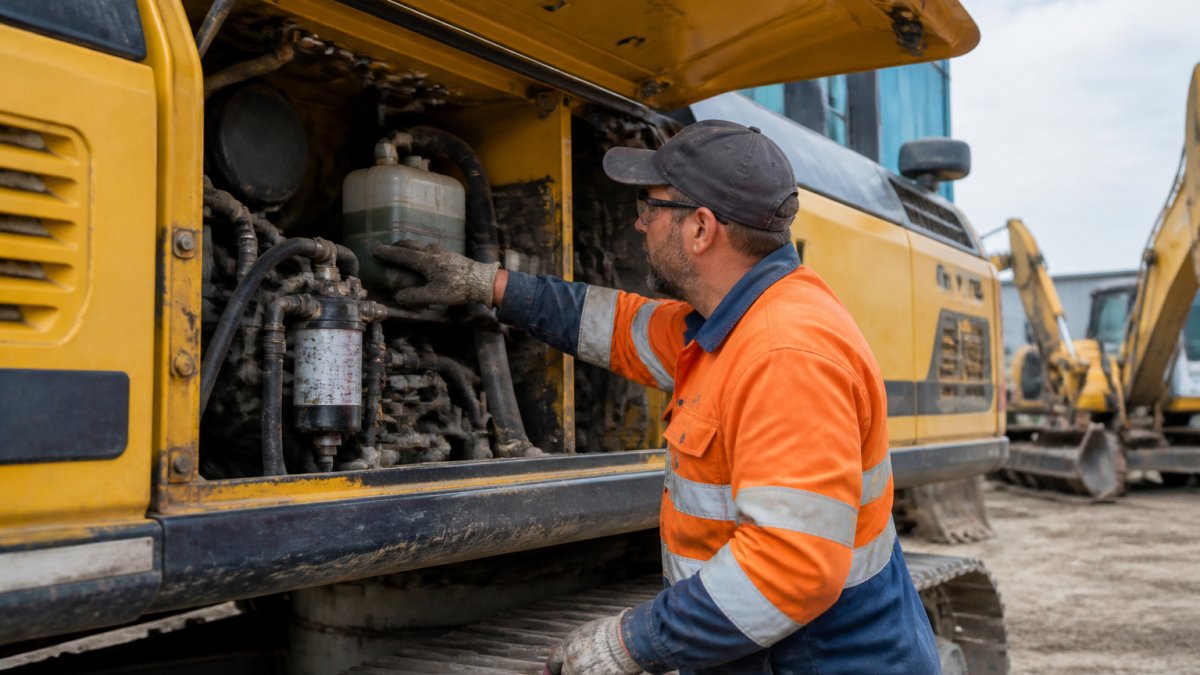
Fuel costs scale with use. A mini excavator burns 1-2 gallons per operating hour.
Maintenance and repairs accelerate as machines age.
Storage and transportation add up. Parking a heavy machine requires space, either owned land (opportunity cost) or rental ($200-$500 monthly).
Insurance and licensing vary by machine type and your business structure.
Depreciation is the silent killer. Equipment loses 15-20% of value in year one, then 10-12% annually for years two through five.
Financing Your Equipment Investment and Tax Benefits
Most contractors can't write a check for $35,000-$100,000 in equipment. Financing makes ownership accessible, but loan terms dramatically affect profitability.
Equipment loans typically run 36-60 months.
Lease financing (operating leases) offers tax advantages: lease payments are fully deductible as business expenses, reducing taxable income. Equipment purchases offer depreciation deductions under Section 179, allowing businesses to deduct the full equipment cost in the year of purchase (subject to annual limits), which can substantially reduce tax liability in the purchase year.
The tax advantage only matters if you have taxable income to offset.
Equipment Finance Academy provides Quick Equipment Financing. Access the nation's top equipment lenders and tech-powered financing marketplace. Approvals in hours, funding same-day.
The decision to buy heavy equipment ultimately comes down to use projections and honest cash flow modeling.
Start with realistic usage estimates. Project monthly billable days from your current job pipeline, not optimistic forecasts.
Frequently Asked Questions
Is buying heavy equipment a good investment for a small contractor?
Buying heavy equipment is a good investment if you have consistent, paid work that justifies the purchase. Small contractors should calculate expected annual utilization and compare the payback period against financing costs. If you can deploy the machine on paying jobs at least 60-70% of business days annually, ownership often outperforms renting over a 3-5 year horizon. Start with equipment that matches your current project pipeline, not what you hope to land.
How do you calculate the return on investment for heavy equipment?
Calculate ROI by dividing annual profit from the equipment by total investment cost, then multiply by 100. Annual profit equals revenue from jobs using that equipment minus operating costs (fuel, maintenance, repairs, insurance, storage). For example, if a mini excavator generates $40,000 in annual revenue with $15,000 in costs, that's $25,000 profit on a $50,000 purchase: 50% ROI. Most contractors target a payback period of 2-4 years, meaning the machine covers its full cost within that timeframe.
What costs should you consider before buying heavy equipment?
Beyond the purchase price, budget for fuel (diesel costs vary but plan $6-10 per hour of operation), maintenance and repairs (typically 10-15% of purchase price annually), insurance, storage or yard space, licensing, and transportation. Financing interest and depreciation also reduce net returns. Many owners underestimate repair costs in years 3-5. A transparent total cost of ownership calculation that includes all these factors prevents overestimating profitability and helps you decide whether renting is cheaper for occasional use.
Is it better to buy or rent heavy equipment?
Buy if you use the equipment regularly (60%+ of available work days) and can finance it affordably. Rent for short-term projects, seasonal work, or when you're testing demand for a new service line. Rental costs 3-5% of equipment value monthly, so renting a $100,000 excavator costs $3,000-5,000 per month. Over 24 months, that's $72,000-120,000, often more than owning. However, rental eliminates repair risk and storage headaches, making it ideal for one-off jobs or when cash flow is tight.