 how-to
Permits for Moving Oversized Construction Equipment
Table of Contents
- Understanding When Permits Are Required for Oversized Construction Equipment
- Oversize Load Permit Requirements by State
- Heavy Haul Paperwork Checklist
- Oversize Permit Processing Time and Application Steps
- Oversize Load Route Planning and Infrastructure Clearance
- Escort Vehicles, Pilot Cars, and Utility Coordination
- Vehicle Configuration, Axle Spacing, and Load Securement
- Permits Beyond State Oversize and Overweight
- Frequently Asked Questions
Last Updated: October 10, 2026
Understanding When Permits Are Required for Oversized Construction Equipment
Obtaining oversized construction equipment permits is required when loads exceed federal and state dimension and weight thresholds.
These rules protect road infrastructure and public safety by preventing bridge damage, power line hazards, and traffic risks.
Legal dimension and weight thresholds
Most states follow federal guidelines with standard limits: 8'6" width, 13'6" height, 53-foot length, and 80,000 pounds gross weight. Any load exceeding these limits requires a permit, though some states vary. Always verify your specific route before transport.
Height restrictions are most restrictive, excavators, cranes, and stacked equipment easily exceed 13'6".
Weight limits apply to individual axles and total load. Single axles max at 20,000 pounds; tandem axles around 34,000 pounds. Distributing weight across more axles helps stay legal.
Equipment that typically requires permits
Heavy construction equipment, excavators, dozers, loaders, cranes, pile drivers, and drilling rigs, almost always requires permits. Even compact equipment on flatbeds can exceed height or weight limits. Assume you need a permit; the cost is far less than fines or liability from unpermitted moves.
Oversize Load Permit Requirements by State
State regulations vary significantly, requiring verification for each jurisdiction on multi-state moves.
How state thresholds differ
Width limits range from 8 to 9 feet; height from 13'6" to 14 feet depending on state and conditions. Length and weight tolerances vary by trailer type and axle configuration. Permit fees range from $50 to $500 per state, with multi-state permits costing more.
Multi-state moves and permit sequencing
Multi-state moves require permits from each state in sequence. Some states require adjacent-state permits before issuing their own. Permits typically take 5-10 business days; expedited processing costs extra. Document your route precisely, including highways, roads, and bridges.
Heavy Haul Paperwork Checklist
Applying for oversized construction equipment permits requires specific documentation. Missing paperwork delays approval. Gathering documents beforehand accelerates the process.
Documentation you'll need before applying
Gather equipment specifications (height, width, length, certified weight, axle configuration), vehicle information (make, model, year, VIN), detailed route map with all highways and bridges, liability insurance ($500,000-$1,000,000 minimum), load securement details with photos, and contact information for shipper, carrier, and owner.
Common application errors to avoid
Common errors: underestimating dimensions (measure complete load assembly), inaccurate weight (use certified scales, round up), vague routes (provide turn-by-turn directions), outdated insurance (verify coverage for heavy haul), ignoring seasonal restrictions, and applying for wrong permit type. Clarify whether you need separate oversize and overweight permits.
Oversize Permit Processing Time and Application Steps
Most states now accept online permit applications. The process is straightforward once you gather required documents.
How to apply online in most states
Visit the state transportation department website and search for "oversize permit." Create an account, fill out the application with equipment specifications, and upload documentation. Review for accuracy, submit, and monitor status online. Receive your permit via email or mail. Understand whether your permit is valid for single or multiple trips.
Lead times and approval timelines
Standard processing takes 5-10 business days with complete documentation. Expedited processing takes 1-3 days for $50-$200 extra. Emergency permits are rare and costly. Plan your schedule accordingly, applying early and requesting expedited processing if needed within 2 days.
Oversize Load Route Planning and Infrastructure Clearance
Choosing the right route is critical for oversized construction equipment transport. Not all roads can handle oversize loads. Some routes have weight restrictions, height clearances, or width limitations.
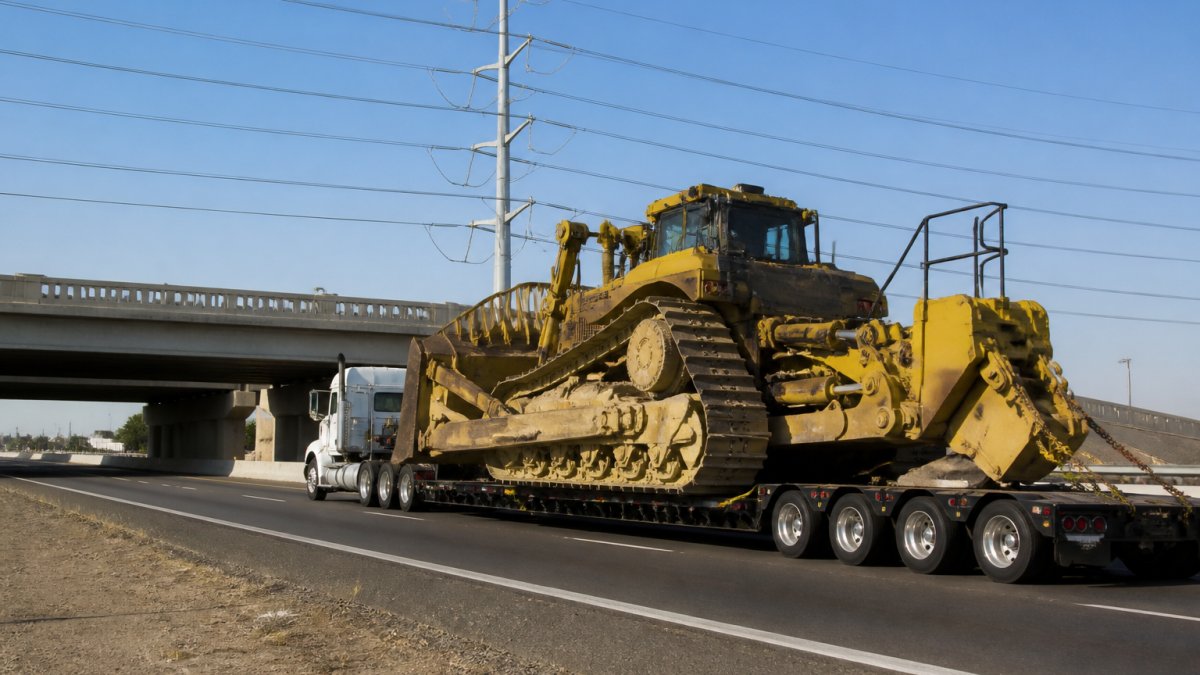
Surveying routes for height and width clearance
Height clearance is the primary concern for tall equipment. Bridges, overpasses, power lines, and traffic signals all pose risks.
Measure clearances along your planned route. Use Google Street View to identify low-clearance areas.
Many states provide clearance maps online. These maps show bridge heights, power line locations, and other obstacles. Download these before planning your route.
If clearance is tight, consider alternative routes even if they're longer. The extra distance is worth avoiding damage and delays.
Width clearance matters less than height but still requires attention. Some roads have width restrictions on certain segments.
Scout your route in advance if possible. Drive the route yourself before transport. Note any areas that look problematic. Photograph clearance points for documentation.
Road restrictions and permitted corridors
Not all roads permit oversized loads. Some routes are restricted to certain times or seasons. Others prohibit oversized loads entirely.
States designate "permitted corridors" for oversized loads. These are routes approved for heavy haul transport. Use these corridors whenever possible.
Urban areas often restrict oversized loads. City streets may be too narrow or have overhead obstacles.
Residential areas typically prohibit oversized loads. States want to minimize disruption and risk to neighborhoods. Plan routes avoiding residential zones.
Seasonal restrictions apply in many states. Spring thaw periods restrict certain routes due to road damage risk. Winter weather may limit transport windows.
Some states require permits to use specific corridors. Your permit may restrict you to certain highways. Follow these restrictions precisely.
Escort Vehicles, Pilot Cars, and Utility Coordination
Oversized loads often require escort vehicles. These vehicles warn other drivers and assist with route management. Utility coordination ensures safe passage past power lines and communications infrastructure.
When escorts are required
Most states require escorts for loads exceeding certain dimensions. A common threshold is 12 feet wide or 14 feet tall.
Weight also triggers escort requirements. Loads exceeding 100,000 pounds often need escorts. Some states set lower thresholds.
Pilot cars precede the oversized load. They scout the route, identify obstacles, and warn approaching traffic. One pilot car leads the load.
Professional pilot car operators know the routes and regulations. They communicate with the load operator via radio.
Some states allow owner-operators to provide their own escort vehicles. Others require certified pilot car services. Check your state's requirements.
Escort costs vary by distance and complexity. Simple routes with one pilot car cost less.
Coordinating with utility companies
Power lines, telephone cables, and fiber optics cross roadways everywhere. Contacting utility companies before transport prevents outages and damage.
Call your state's "Call Before You Dig" service. Provide your route details. They'll notify all utility companies in the area.
Utility companies will mark cable and line locations. They may require additional clearance or special handling. Some utilities dispatch representatives to monitor your load's passage.
In some cases, utilities will de-energize power lines during transport. This adds cost but ensures safety. Plan ahead for utility coordination.
Coordinate with local authorities for street closures or traffic control. Some routes require temporary traffic signals or lane closures. Local police departments can assist with traffic management.
Vehicle Configuration, Axle Spacing, and Load Securement
How you configure your vehicle and load affects permit requirements. More axles allow heavier loads. Proper load securement prevents cargo shift and accidents.
Trailer type and axle count considerations
Standard dual-axle trailers can carry loads up to about 80,000 pounds gross weight. Tandem-axle configurations allow heavier loads. Tri-axle trailers support even greater weights.
More axles distribute weight across more road surface. This reduces road damage and increases load capacity. States allow heavier loads on multi-axle configurations.
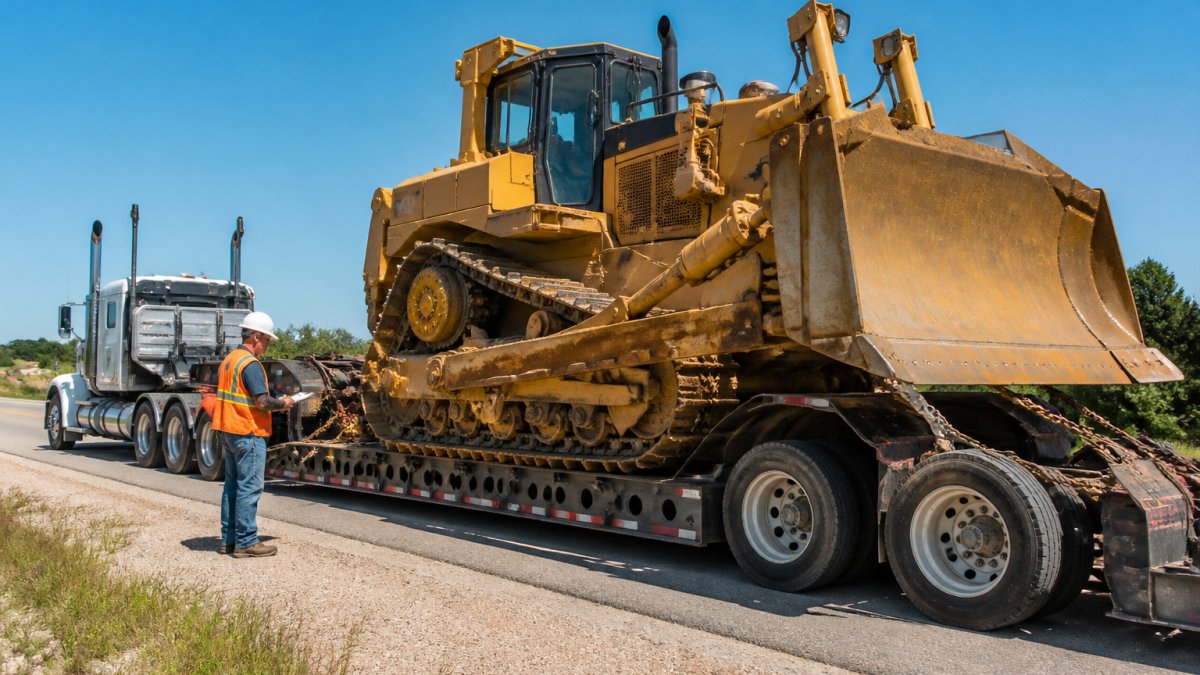
Lowbed trailers work well for construction equipment. Their low deck height helps stay within height limits. Gooseneck connections improve maneuverability.
Flatbed trailers offer flexibility for various equipment shapes. They work for dozers, excavators, and loaders. Ensure proper tie-down points are available.
Specialized trailers like heavy-haul or modular units suit extreme loads. These cost more but handle difficult configurations. Use them for loads that standard trailers cannot accommodate.
Gross vehicle weight and load distribution
Gross vehicle weight rating (GVWR) is the maximum weight your vehicle can safely carry. Exceeding GVWR risks brake failure and accidents.
Distribute load weight evenly across axles. Front axles should carry 20 to 25 percent of total weight. Rear axles carry the remainder.
Uneven weight distribution stresses tires and suspension. It can cause trailer sway and jackknifing. Proper distribution improves safety and fuel efficiency.
Weigh your loaded vehicle on certified scales. Record the weight on each axle. Ensure no axle exceeds its weight rating.
Some states allow slightly higher weights on certain routes. Document these allowances in your permit. Carry weight tickets proving compliance.
Permits Beyond State Oversize and Overweight
State permits cover highway transport. Local permits address city and county roads. Bridge-specific permits protect infrastructure.
Local municipal and county permits
Cities and counties issue their own permits for oversized loads. These cover local roads, not state highways.
Contact city and county authorities along your route. Provide your load specifications and planned route. They'll issue permits or deny access.
Some municipalities charge additional fees for oversized loads. Others restrict transport to specific times or routes.
Bridge weight limits vary by location. A bridge rated for 80,000 pounds may not handle heavier loads. Check bridge ratings before transport.
Some jurisdictions require traffic control plans. You may need to hire police details or traffic control companies. These costs add up quickly.
Bridge weight limits and special route permits
Historic bridges often have strict weight limits. A bridge built in 1950 may only support 60,000 pounds.
States maintain bridge inventory databases. These list weight ratings for every bridge. Check your route against these databases.
Some bridges require special permits beyond standard oversize permits. These "special route permits" document that you've verified bridge capacity.
Oversized loads sometimes cannot cross certain bridges. You must find alternate routes.
Contact the state bridge authority if unsure about a bridge. They can provide exact weight ratings and restrictions.
Moving oversized construction equipment requires careful planning and proper permitting.
Equipment Finance Academy helps construction companies and logistics operators secure the financing needed for fleet expansion and equipment acquisition.
Frequently Asked Questions
What is the widest load you can have without an oversize permit?
Standard legal width is 8 feet 6 inches without a permit in most states. Loads exceeding this width require an oversize load permit. Some states allow slightly wider loads on certain roads, but 8 feet 6 inches is the federal standard for interstate commerce. Check your specific state's Department of Transportation website for exact thresholds, as they can vary by road type and location.
When does construction equipment need an overweight permit?
Construction equipment needs an overweight permit when the gross vehicle weight exceeds 80,000 pounds, the standard federal limit. Individual states may have lower thresholds for certain road types or impose stricter limits on state-maintained roads. Axle weight limits also apply separately, typically 20,000 pounds per axle. Verify your state's specific overweight thresholds before transport, as exceeding limits without a permit results in fines and potential equipment impoundment.
How long does it take to get an oversize load permit?
Most states process permits within 3 to 7 business days when submitted online with complete documentation. Emergency or rush permits may be available in 24 hours for an additional fee. Processing times vary by state and permit type, some states require route approval from local agencies, which can extend timelines. Plan for at least one week when budgeting transport schedules, and submit applications well in advance of your move date.
Do I need an escort vehicle to transport oversized equipment?
Escort vehicles are required for loads exceeding certain width, height, or length thresholds, which vary by state. Most states require escorts for loads wider than 12 feet or taller than 14 feet. The permit application specifies whether escorts are mandatory for your specific load. Pilot car operators must be licensed and follow state-specific regulations. Budget for escort costs and coordinate scheduling when planning your heavy haul transport.