 ultimate-guide
The Complete Guide to Crane Maintenance for Owners
Last Updated: October 25, 2026
Quick Summary
Crane maintenance is a structured program of daily visual inspections, weekly component testing, and scheduled overhauls that extends equipment lifespan, maintains safety, and prevents costly downtime. Proper crane maintenance replaces reactive repairs with predictable tasks matched to your equipment's duty cycle and operating conditions.
- Daily inspections catch issues before escalation by checking structural frame, wire rope, hooks, and brakes for 15 minutes before each shift.
- High-duty cranes running 40+ hours weekly need weekly inspections and monthly testing, while low-duty cranes under 10 hours weekly need quarterly full inspections.
- Wire rope diameter loss over 10% indicates internal breakage and requires replacement to maintain load-bearing strength.
- Brake testing under load weekly ensures the brake holds without drift and engages automatically if power is lost.
- Budget 10-15% annually for high-duty equipment maintenance, 5-10% for medium-duty, and 3-5% for low-duty equipment to cover inspections and component replacement.
Table of Contents
- Why Crane Maintenance Matters for Equipment Reliability
- Building a Crane Preventive Maintenance Program
- Crane Maintenance Schedule: Aligning Tasks to Duty Cycles
- Creating a Crane Maintenance Checklist for Consistent Inspections
- Maintaining Crane Maintenance Logs and Records
- Common Maintenance Failures and How to Prevent Them
- Planning Repairs and Managing Maintenance Costs
- Getting Started With Your Crane Maintenance Program
- Frequently Asked Questions
Why Crane Maintenance Matters for Equipment Reliability
Crane maintenance isn't optional, it's the difference between a reliable asset and an expensive liability. A fraying wire rope, fading brakes, or silent structural cracks can turn a routine lift into a catastrophe.
Most owners learn this the hard way: a crane idles for a week, a rigging failure halts a project, a brake fails mid-lift.
Proper crane maintenance extends equipment lifespan, maintains safety, and keeps job sites moving. When you know what each component needs and when, maintenance becomes predictable rather than reactive.
Building a Crane Preventive Maintenance Program
A preventive maintenance program replaces guesswork with a structured system: daily checks, weekly tasks, monthly inspections, and annual overhauls.
Document your crane's specifications: model, capacity, age, and operating hours.
Assign clear responsibility. One person should own the crane maintenance program, keeping records, flagging issues, and coordinating repairs. Without a single point of accountability, tasks slip and the program fails.
Commit to a schedule. Maintenance that happens "whenever we get around to it" doesn't happen.
Daily Visual Inspections
Daily inspections are the frontline defense. Before each shift, a qualified operator or maintenance person walks the crane for 15 minutes, catching issues before they escalate.
Check the structural frame for cracks, bends, or damage, and welds for stress or separation.
Document findings with a simple checklist: date, operator name, items checked, issues noted. Over time, records reveal patterns, a progressively fraying rope signals upcoming replacement, and degrading brake response flags maintenance needs.
Weekly and Periodic Inspection Schedules
Weekly inspections go deeper, adding component testing, measurement, and operational verification. A qualified technician spends 30-45 minutes on them.
Test the brake under load, confirming it holds without drift. Measure wire rope diameter against baseline, since shrinking rope loses strength. Inspect hooks for cracks visually and, if needed, with magnetic particle testing.
Monthly inspections add depth: lubrication systems checked, structural bolts torque-tested, hoist mechanisms run through full range of motion, and rigging components examined.
Crane Maintenance Schedule: Aligning Tasks to Duty Cycles
A crane maintenance schedule isn't one-size-fits-all. A tower crane running 40 hours weekly needs tighter inspection intervals than a mobile unit used 10 hours monthly.
High-duty cranes (40+ hours weekly) need weekly inspections, monthly component testing, and quarterly deep dives.
Document actual operating hours using hour meters, reviewing them monthly. When hours exceed thresholds, escalate your maintenance response, avoiding over-maintaining low-use equipment or under-maintaining high-use equipment.
Maintenance frequency and component lifespan vary significantly based on how intensively your crane operates.
| Duty Level | Operating Hours Weekly | Inspection Frequency | Wire Rope Lifespan |
|---|---|---|---|
| High-duty | 40+ hours | Weekly, monthly testing, quarterly deep dives | 12 months |
| Medium-duty | 10-40 hours | Weekly visual, monthly inspections, semi-annual reviews | varies |
| Low-duty | Under 10 hours | Weekly visual, quarterly full inspections, annual overhauls | 24-36 months |
Creating a Crane Maintenance Checklist for Consistent Inspections
A maintenance checklist standardizes what gets checked and when. It removes ambiguity. Every inspection covers the same items in the same sequence.
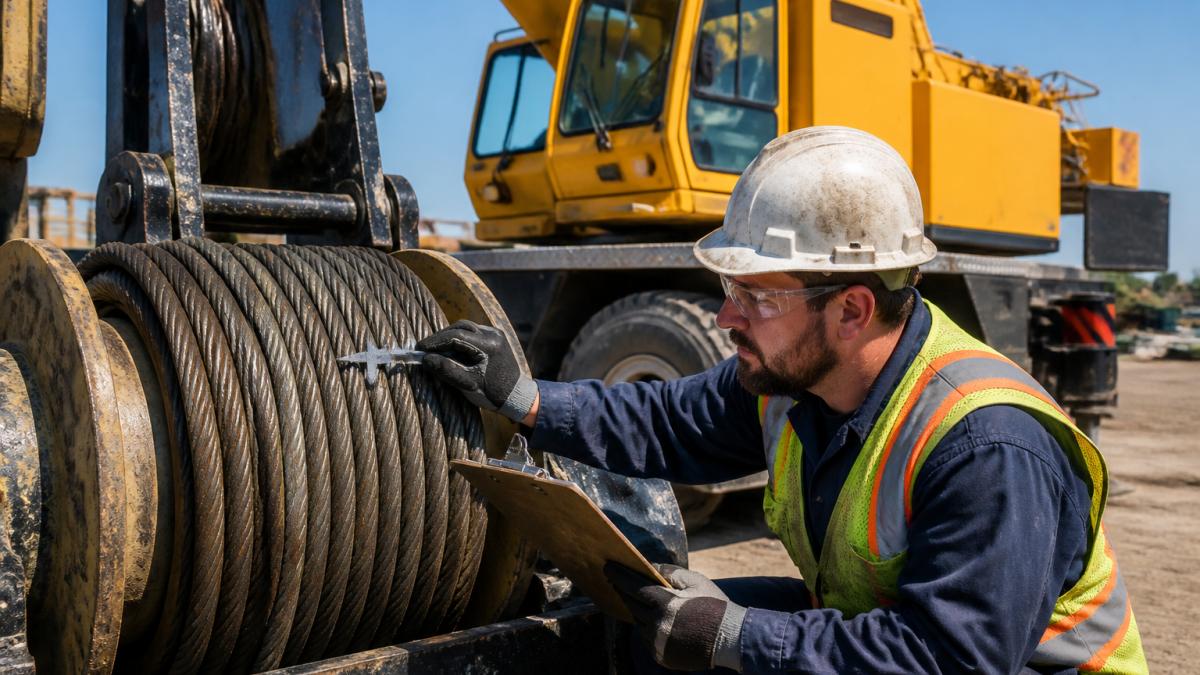
Your checklist should cover structural components, mechanical systems, electrical systems, rigging equipment, and safety devices.
Include space for notes. When an item fails or shows degradation, document location, severity, and recommended action, since this history guides repair-versus-replace decisions.
Organize your checklist by system: structural frame, hoist mechanism, electrical, rigging, then brakes. This sequence makes inspections efficient and ensures nothing gets skipped.
Wire Rope Inspection and Care
Wire rope is the most critical component in any crane system, bearing the entire load.
Examine rope visually for fraying, kinks, or corrosion, and measure diameter at multiple points.
Count visible broken wires. A few are normal wear, but many in a localized area signal imminent failure.
Lubricate wire rope regularly, since dry rope corrodes faster and becomes brittle.
Inspect rope end attachments: sockets secure, swages free of cracks, splices tight. A rope that slips in its attachment can fail suddenly under load.
Hooks, Hook Blocks, and Rigging Components
Hooks and hook blocks experience enormous stress. They wear, deform, and crack. Regular inspection prevents catastrophic failure.
Inspect hooks for cracks, especially at the throat where stress concentrates.
Check hook blocks for cracks in the cast iron or ductile iron body. Cracks typically start at stress points and grow under load.
Examine all rigging equipment: shackles, slings, spreader bars, and lifting lugs. Look for bent, cracked, or corroded components.
Document the inspection date on each rigging component. Most slings and rigging hardware have rated service lives.
Brake Inspection and Testing
Brakes are your safety system. They stop loads and hold them in place.
Test brakes under load weekly. Raise a test load to mid-height and engage the brake. The load should hold without drift.
Inspect brake pads or linings for wear. Measure thickness and compare to specification.
Check brake fluid level if your brake system is hydraulic. Low fluid indicates a leak.
Verify that the brake engages automatically if power is lost. This is a critical safety feature.
Electrical System and Lubrication
Electrical systems power your crane. Corroded connections, damaged wiring, and worn contactors reduce reliability and create safety hazards.
Inspect all electrical connections for corrosion, especially outdoors where moisture and salt air accelerate corrosion.
Examine wiring for damage, cuts, or abrasion. Damaged insulation exposes conductors and creates shock hazards.
Test the emergency stop button. It should cut power immediately when pressed. If it doesn't, repair or replace it.
Lubrication extends mechanical life. Gearboxes, motors, and bearings need regular lubrication. Check lubricant levels monthly. Top up as needed.
Maintaining Crane Maintenance Logs and Records
Maintenance records are your evidence. They prove you've maintained the equipment according to standards. They show patterns of wear and degradation.
Create a maintenance log for each crane. Record every inspection, every repair, every component replacement.
Digital record-keeping is more reliable than paper. A spreadsheet or maintenance management software creates searchable records and automatic reminders for upcoming tasks.
Document component replacement dates.
Keep inspection reports accessible. If an incident occurs, you need to quickly demonstrate that you've maintained the equipment properly.
Common Maintenance Failures and How to Prevent Them
Maintenance programs fail for predictable reasons. Understanding these failures helps you avoid them.
Incomplete inspections are common. Someone checks the obvious items but misses critical components. Wire rope gets inspected, but brake systems don't.
Deferred repairs are another failure mode.
Poor record-keeping obscures patterns. Without records, you can't see that a particular component fails regularly.
Inadequate training is another pitfall. Operators and maintenance staff don't know what to look for. They perform inspections but miss critical issues.
Planning Repairs and Managing Maintenance Costs
Maintenance has costs. Planning those costs prevents budget surprises and ensures you can maintain equipment properly.
Categorize maintenance into three buckets: routine maintenance (daily and weekly inspections), scheduled maintenance (monthly and annual overhauls), and emergency repairs (failures that occur unexpectedly). Routine and scheduled maintenance are predictable and budgetable. Emergency repairs are not.
Budget for routine maintenance as a percentage of equipment value. Use our equipment financing calculator to estimate monthly payments for crane repairs and replacements.
Track actual spending against budget.
Plan for major repairs and replacements. Wire rope, brakes, and other major components have predictable service lives.
Consider whether to repair or replace aging components. A brake that's worn might be rebuilt for $5,000 or replaced for $8,000.
Getting Started With Your Crane Maintenance Program
Starting a crane maintenance program requires commitment but pays dividends in reliability and safety. Begin by auditing your current state.
Assign responsibility. Identify the person who will own the maintenance program.
Create your maintenance schedule. Use the manufacturer's recommendations as a starting point.
Develop your inspection checklists. Customize them for your equipment and operating environment.
Start tracking. Begin recording inspections, repairs, and component replacements.
Finally, review and adjust quarterly. Maintenance programs improve over time as you learn what works.
Frequently Asked Questions
How often should a crane be inspected and maintained?
Daily visual inspections should occur before operation to catch obvious damage or wear. Weekly inspections examine specific components like wire rope, hooks, and brakes. Monthly and quarterly maintenance schedules address lubrication, alignment, and structural integrity. The exact frequency depends on your crane's duty cycle and operating hours. Heavy-use cranes require more frequent inspections than those used occasionally. Establish a crane maintenance schedule based on manufacturer recommendations and your job site demands.
What should be included in a crane maintenance checklist?
A comprehensive crane maintenance checklist covers wire rope condition (for kinks, corrosion, or broken strands), hooks and hook blocks (for cracks or wear), brakes (testing stopping distance and responsiveness), electrical systems (checking controls and safety switches), lubrication points, structural alignment, and load-handling performance. Your checklist should also track operator observations, recent repairs, and any anomalies. Use a crane maintenance log template to document findings consistently, which helps identify patterns and schedule preventive work before failures occur.
What are the most common signs that a crane needs maintenance?
Watch for jerky or uneven movements during load handling, unusual noises from the motor or hoist, visible rust or corrosion on structural components, fraying or discolored wire rope, brake lag or reduced stopping power, and electrical control delays. Leaking hydraulic fluid, worn hook grooves, and misaligned trolleys also signal maintenance needs. Operators should report any change in performance immediately. Early detection through daily inspections prevents catastrophic failures and unplanned downtime that disrupts job site operations and increases repair costs.
How can crane owners prevent unexpected breakdowns?
Establish a crane preventive maintenance program with scheduled inspections tied to operating hours and duty cycles. Keep detailed crane maintenance logs to spot wear trends before components fail. Replace consumables like grease and hydraulic fluid on schedule. Train operators to perform pre-shift visual checks and report anomalies. Address minor repairs promptly rather than deferring them. Regular lubrication, brake testing, and structural inspections reduce failure risk significantly. Preventive maintenance costs less than emergency repairs and keeps equipment on the job longer.
What maintenance records should crane owners keep?
Maintain a crane maintenance log template that documents daily visual inspections, weekly component checks, monthly lubrication and alignment tasks, and any repairs performed. Record the date, time, inspector name, findings, and actions taken. Track operating hours to correlate maintenance intervals. Keep copies of manufacturer service bulletins and inspection reports. Store records for the equipment's lifespan for warranty claims and resale documentation. Digital records or a maintenance log template make it easy to retrieve history, identify recurring issues, and demonstrate compliance with safety standards.
When should a crane be taken out of service for repairs?
Remove a crane from service immediately if wire rope shows broken strands, hooks have visible cracks, brakes fail stopping tests, or electrical controls malfunction. Structural damage, severe corrosion, or hydraulic leaks also warrant shutdown. Do not operate equipment with missing safety guards or non-functional warning systems. Perform repairs before returning the crane to the job site. Test load handling and brake response after repairs. Document the downtime and repair work in your crane maintenance log to track equipment reliability and plan future maintenance intervals.
Can operators perform routine crane maintenance?
Operators can perform daily visual inspections and report findings, but qualified technicians should handle detailed maintenance. Operators check for obvious wear, corrosion, or damage and note any performance changes. Lubrication, brake testing, electrical diagnostics, and wire rope inspection require training and specialized tools. Some routine greasing may fall to operators if properly trained, but structural repairs and component replacement belong to certified technicians. Clear roles prevent safety gaps and ensure maintenance quality. Document who performed each task in your crane maintenance log.
Crane maintenance isn't glamorous, but it's essential. When your equipment is maintained properly, it works reliably and safely. When it's neglected, it fails at the worst possible time. The choice is yours. Contact our team to discuss how equipment financing can help you invest in maintenance and upgrades that keep your cranes operating at peak performance.