 how-to
7 Crane Operator Certification Requirements for Buyers
Last Updated: October 31, 2026
Quick Summary
Crane operator certification is a portable credential from a recognized certifying body showing the operator passed written and practical exams for a specific crane type. It is not a license and does not replace your own duty to evaluate the operator, so buyers must verify the certificate number, scope, expiration date, and identity before hiring.
- Ask for the certificate number and certifying body name, then confirm the credential against the issuing organization's own record.
- Match the crane type and capacity printed on the card to the equipment your lift actually requires.
- Record every operator's expiration date at booking and set a calendar reminder 60 to 90 days before it lapses.
- A training certificate proves attendance, not certification, so request the certification record separately.
- Confirm any state or local license and document your own employer evaluation for your site conditions.
Table of Contents
- Why Buyers Must Verify Crane Operator Certification
- OSHA Crane Operator Certification Requirements Explained
- Certification, Licensing, Training, and Employer Evaluation: What's the Difference
- Crane Operator Certification Requirements by Crane Type
- How to Verify Crane Operator Certification Before You Hire
- Crane Operator Certification Renewal and Retesting Logistics
- Your Buyer Due Diligence Checklist for Operator Credentials
- Financing the Crane and Crew Your Project Requires
- Frequently Asked Questions
Why Buyers Must Verify Crane Operator Certification
A crane operator certification is a portable credential that shows an operator passed a written and practical exam for a specific crane type. It is not a license, and it does not replace your own duty to evaluate the operator.
Here is the core problem. A certificate proves someone passed a test on a given day. It does not prove the operator has run your crane, on your site, under your lift plan.
Below, we will show you exactly how to read a certificate, what OSHA actually requires, and where certification ends and your responsibility begins.
OSHA Crane Operator Certification Requirements Explained
OSHA requires crane operators to be trained and evaluated, and the federal rule ties operator qualification to recognized certification for equipment covered by the standard. The exact language lives in the OSHA crane operator qualification rule, and it is worth reading directly rather than trusting a summary.
What does that mean in plain terms?
- Operators must be trained on the specific equipment they run.
- They must be evaluated by a qualified person.
- Certification through a recognized body satisfies part of that requirement for covered crane types.
- The employer, not the certifying body, still owns the duty to confirm competency.
That last point is the one buyers miss. The certifying body tests the operator. You confirm the operator can do your job. Those are different questions.
Certification, Licensing, Training, and Employer Evaluation: What's the Difference
Four terms get used as if they mean the same thing. They do not, and mixing them up is how buyers end up with an uncertified operator on a certified crew. The fastest way to sort them is to ask two questions about any document an operator hands you: who issued it, and what does it actually authorize?
Certification is a credential issued by a recognized certifying body after the operator passes a written examination and a practical examination for a specific crane type.
Licensing is a government-issued permission to operate. It comes from a state or local authority, not a certifying body.
Training is instruction. It can come from an apprenticeship, a trade school, a manufacturer program, or an employer's own onboarding. Training produces a certificate of completion, which is not the same document as a certification card.
Employer evaluation is your own documented assessment that the operator can safely run the equipment on your site, under your conditions.
Here is the mapping that matters for a buyer:
- Federal layer. The federal crane standard requires operators to be trained and evaluated. Confirm the current federal requirements in the official OSHA source.
- State layer. Some states impose their own operator licensing or registration on top of the federal rule. Check the requirements for the state where your site sits with that state's official source.
- Local layer. Some local jurisdictions add permitting or licensing for crane work inside their limits. Check with the local authority where the site is located.
- Contract layer. Your own insurance carrier, general contractor, or project owner may require a specific certification body or a minimum experience threshold that exceeds any government rule.
When you request credentials, ask for all four categories by name. An operator or staffing firm that can produce certification, any required license, training history, and a prior employer evaluation is showing you a complete file. One that produces only a laminated card is showing you one quarter of the picture.
Crane Operator Certification Requirements by Crane Type
Crane operator certification requirements by crane type vary, and this is where a single card falls short. Certifying bodies typically issue credentials tied to equipment classification, so an operator certified on a small boom truck is not automatically cleared for a large lattice-boom crawler.
The practical split looks like this:
- Mobile cranes such as truck-mounted and rough-terrain units usually require type-specific certification.
- Tower cranes often carry their own certification path and, in some jurisdictions, additional licensing.
- Overhead and gantry cranes may fall under a different training and evaluation structure than mobile lifting equipment.
- Articulating boom cranes and similar specialty units may need a separate endorsement.
Check the scope printed on the card. If your lift needs a 200-ton crawler and the operator's certificate covers a 30-ton boom truck, the credential does not match the job.
How to Verify Crane Operator Certification Before You Hire
Verification is a five-step process, and none of the steps take long.
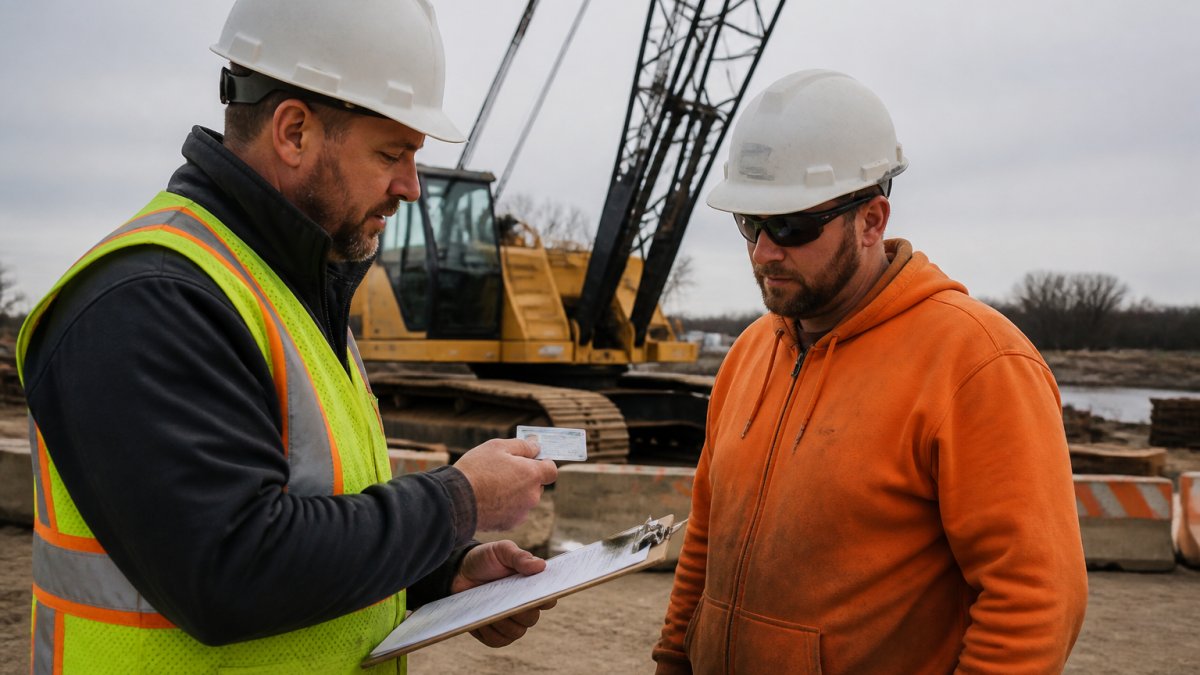
- Get the certificate number and certifying body name. Ask for a photo of the card, front and back.
- Confirm the certifying body is recognized. Not every card comes from an accredited organization.
- Check the scope. Match the crane type and capacity on the card to your equipment.
- Confirm the expiration date. Certifications are time-limited and typically require renewal. Confirm the expiration date with the certifying body.
- Cross-check the operator's identity. Photo identification should match the name on the certificate.
Where available, use the certifying body's lookup tool or phone line to confirm a credential is active. Confirm against the issuing organization's own record rather than relying on a photocopy.
The same due-diligence habit applies to the machine itself. If you want to see how to trace a crane's service records before you commit, our guide on how to verify heavy equipment service history walks through the paperwork trail.
Watch out: hiring on a photocopy alone is the single most common verification failure. Always confirm against the certifying body's own record.
Verification is a five-step process, and none of the steps take long.
| Step | What to do |
|---|---|
| 1 | Get the certificate number and certifying body name |
| 2 | Confirm the certifying body is recognized |
| 3 | Check the scope matches your crane type and capacity |
| 4 | Confirm the expiration date with the certifying body |
| 5 | Cross-check the operator's identity against photo ID |
Crane Operator Certification Renewal and Retesting Logistics
Crane operator certification renewal runs on a cycle set by the certifying body. Confirm the current interval and retest format directly with that organization.
Timelines to build into your schedule.
- Application and scheduling lead time. Recertification windows and exam slots vary by body and by testing location. Ask the operator when they plan to schedule, not just when the card expires.
- Study and preparation time. Either way, the preparation happens on the operator's time, not yours.
- Retest turnaround. If an operator fails a recertification exam, the body's retest policy governs how soon they can try again. Check the body's retest policy for the waiting period before a retest. A failed recertification can take an operator off your crew for longer than the expiration date alone suggests.
What a lapse actually means. An expired card usually means the operator cannot work on covered equipment until renewal is complete.
Costs. Recertification fees are set by the certifying body. Confirm the current fee schedule with the issuing organization.
Out-of-state and multi-jurisdiction credentials. A credential valid in one jurisdiction may not satisfy local licensing elsewhere.
A buyer's renewal checklist:
- Expiration date recorded at booking and confirmed against the certifying body's record
- Recertification scheduled or completed before the expiration date
- Retest policy confirmed with the issuing body if the operator has a failed attempt
- Local license renewal cycle checked separately where a license is required
- Calendar reminder set 60 to 90 days before expiration for long projects
Renewal is where a clean credential file quietly goes stale.
Your Buyer Due Diligence Checklist for Operator Credentials
Use this checklist before you sign a crew to your site. It covers the gaps a certificate alone will not close.
- Certificate number recorded and confirmed with the certifying body
- Certifying body is a recognized accrediting organization
- Crane type and capacity on the card match your equipment
- Expiration date falls after your project completion
- Photo identification matches the operator's name
- State or local license confirmed where required
- Employer evaluation documented for your site conditions
- Insurance coverage confirmed for the operator and the crane
- Substance abuse testing policy confirmed with the employer
That insurance line deserves its own check. Our breakdown of used crane insurance coverage requirements covers what to confirm before the machine and crew arrive.
Document everything. If an incident happens, your qualification documentation is the record that shows you did the check.
Financing the Crane and Crew Your Project Requires
Credentials are only half the equation. The other half is capital, and a certified crew on a crane you cannot afford helps no one.
When you are ready to move, our industry-specific equipment financing is built for construction, trucking, and manufacturing operations that need to close fast. Approvals can come in hours, with funding the same day.
If the crane purchase is part of a larger capital plan, look at how the Section 179 deduction can offset the cost of equipment you place in service this year.
Ready to start? You can begin your financing application and get a decision without a long wait.
Frequently Asked Questions
What are the OSHA requirements for crane operator certification?
OSHA requires crane operators to be trained and evaluated for equipment covered by the standard. Confirm the current requirements in the official OSHA source, and ask for the operator's certification and the employer's evaluation records. Buyers should ask for both the certification card and the employer's evaluation records, since certification alone does not satisfy every requirement.
How can buyers verify a crane operator's certification?
Check the certification card for the operator's name, photo identification, certifying body, crane type, and expiration date. Then confirm the credential directly with the issuing organization, either through its online registry or by phone. Match the certification scope to the crane the operator will run on your project. A card that lists a different crane type or has lapsed does not cover the work you are hiring for, so verification should happen before the operator starts.
Does crane operator certification depend on the type of crane?
Yes. Certifications are issued by crane type and equipment classification, so an operator certified on a mobile telescopic boom crane may not be certified for a tower crane or an overhead crane. Ask which specific crane types the credential covers and compare that list to the equipment on your site. If the job involves more than one crane type, confirm the operator holds certification for each one before assigning the work.
What is the difference between crane operator certification and employer evaluation?
Certification is a credential issued by a recognized accrediting or testing organization after written and practical examinations. Employer evaluation is a separate step where the employer confirms the operator can safely run the specific equipment on the specific job site. OSHA expects both. For buyers, this means checking the certification card and asking the employer for evaluation documentation covering the crane and conditions on your project.
The real test of a crane crew is not the card in the wallet. It is whether you can prove, on paper, that the operator, the machine, and the insurance all match the job. Equipment Finance Academy helps construction and logistics operators finance the equipment their projects demand, with a marketplace of lenders, approvals in hours, and same-day funding. Get started with Equipment Finance Academy and put a certified crew on a financed crane without draining your cash reserves.