 how-to
How to Verify Heavy Equipment Title Authenticity
Last Updated: November 2, 2026
Quick Summary
To verify heavy equipment title authenticity, request the original certificate of title and bill of sale before you inspect, then match the seller's name, machine make, model, year, and serial number to the documents. Confirm the title is an original, not a photocopy, and check for any lender listed as lienholder or secured party.
- Ask for the title and bill of sale up front; a seller who stalls is your first red flag.
- A UCC financing statement is indexed by the debtor's name, not the equipment's serial number.
- Search UCC records in every state where the seller has been organized or operated.
- A bonded title does not clear a UCC lien; run the lien search first.
- Get a payoff letter in writing and the termination statement filed before releasing funds.
Table of Contents
- Step 1: Request the Title and Bill of Sale Before You Inspect
- Step 2: Run a Heavy Equipment Serial Number Check on the Machine
- Step 3: Complete a Heavy Equipment Lien Check Through UCC Filings
- Step 4: Run a Stolen Equipment Lookup Across Databases
- Step 5: Confirm Seller Identity and Ownership Documentation
- Step 6: Understand State Title Rules and How to Transfer Ownership of Heavy Equipment Without Title
- Step 7: Use a Physical Inspection Checklist Before You Pay
- Financing a Verified Machine: Your Next Step
- Frequently Asked Questions
Step 1: Request the Title and Bill of Sale Before You Inspect
Learning how to verify heavy equipment title authenticity starts with the heavy equipment title itself, before you touch a machine.
A bill of sale is a written record of the sale naming the buyer, seller, machine, and price.
A certificate of title is the official document naming the legal owner.
- Match the seller's name to the name printed on the title
- Check the machine's make, model, year, and serial number against the listing
- Look for a lender listed as lienholder or secured party
A common mistake is accepting a photo of a title over text. Photos hide watermarks, alterations, and fine print.
Step 2: Run a Heavy Equipment Serial Number Check on the Machine
A heavy equipment serial number check confirms the machine is the one the paperwork describes.
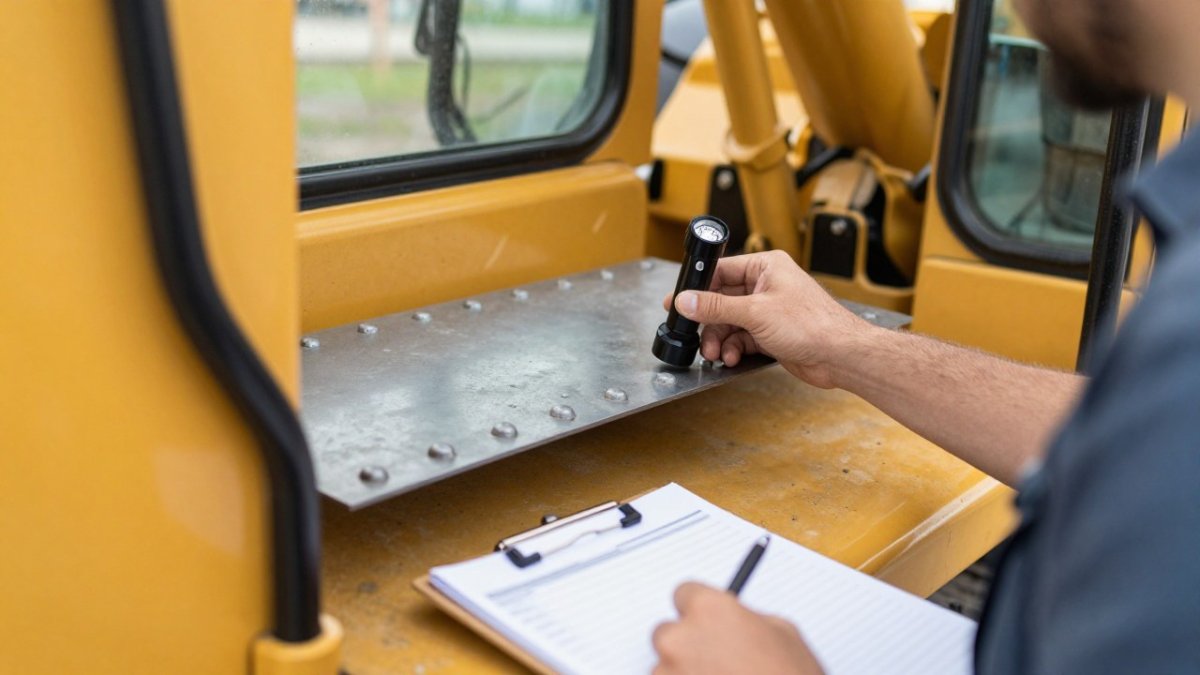
The number usually lives on a PIN plate, a riveted metal tag fixed to the frame, or is stamped directly into the metal.
Then run what you found through a stolen equipment lookup and any available equipment history services. A clean lookup is one more layer of protection.
How to Read a PIN Plate and Spot Tampering
Serial number tampering is more common than most buyers expect. Watch for these signs:
- Rivets that look wrong. Factory rivets are uniform; replacements sit unevenly or show tool marks.
- Grinding or sanding near the plate. Fresh scratches suggest someone removed or altered it.
- Stamped numbers that look hand-cut. Factory stamping is even and consistent in depth.
If the plate looks disturbed, walk away. You can read more about spotting altered numbers in our guide on signs of heavy equipment odometer tampering.
Step 3: Complete a Heavy Equipment Lien Check Through UCC Filings
A heavy equipment lien check tells you whether a lender has a claim on the machine. You run it through UCC filings, the public records lenders file under Article 9 of the Uniform Commercial Code to record a security interest in equipment.
A UCC filing is a public notice that a lender holds an interest in specific equipment until a loan is repaid. The debtor is the borrower. The secured party is the lender.
How a UCC Filing Is Indexed
This is the part most buyers miss. A UCC financing statement is indexed by the debtor's name, not the equipment's serial number. You search the seller's legal name, and the filing's collateral description tells you whether your machine is covered.
- Individuals: search the exact name on the driver's license or title, including middle name or initial. A filing under "Robert J. Smith" will not surface in a search for "Bob Smith."
- Registered businesses: search the exact legal entity name as registered with the state, plus any trade names or DBAs.
- Name changes: if the seller recently changed a business name or married, search both old and new names.
What a Search Actually Returns
A UCC search result lists filings, each with a filing number, filing date, debtor name, secured party name, and collateral description. Read the collateral description closely. It may say "all equipment now owned or hereafter acquired," a blanket lien that can sweep in your machine even though the serial number never appears. It may instead list a specific serial number or a description like "2019 Caterpillar 320 excavator, PIN CAT0320XXXX."
- Search the UCC records in the seller's state of organization (for a business) or residence (for an individual), using the exact legal name
- Search under the business name and every trade name the seller uses
- Read each filing's collateral description and flag any that could cover the machine
- Check the filing date and whether a continuation statement has kept it active
- Request a payoff letter from any lender that shows up
- Confirm the filing is terminated or satisfied before you pay
Continuations, Terminations, and Lapse
A UCC filing does not last forever.
Watch out: a filing that looks expired on the search screen may have been continued under a different filing number, so confirm the status with the state's filing office.
A payoff letter states the exact amount owed to clear the lien.
You can search UCC records through your state's Secretary of State office.
The Gap Most Guides Skip: Lien Searches Across State Lines
Most guides tell you to search the seller's state and stop there. That is not enough for heavy equipment, because machines move. If the seller operates across state lines, or the machine was financed by an out-of-state lender, run the search in every state where the seller has been organized or has operated during the loan period.
A UCC search is only as good as the names and states you search, so here is what to check and what each result means.
| Item | What to do | Note |
|---|---|---|
| Search index | Search the debtor's legal name | Indexed by debtor name, not serial number |
| Individuals | Use exact name on license or title | Include middle name or initial |
| Registered businesses | Search legal entity name plus trade names or DBAs | Search old names after a name change |
| Prior owners | Search the prior owner too | A filing can follow the equipment |
| Collateral description | Read each filing closely | Blanket liens may sweep in your machine |
| Continuation statement | Check filing date and continuation status | Without one, the filing lapses |
| Termination statement | Get it filed before releasing funds | The document you want to see |
| Payoff letter | Request it from any lender that shows up | Get the amount in writing |
Step 4: Run a Stolen Equipment Lookup Across Databases
A stolen equipment lookup checks whether the machine has been reported stolen. Run it before you hand over any money.
Start with your local police department and ask whether the serial number appears in stolen property records. Then check industry databases that track equipment theft.
Cross-check the seller's story too. Ask where the machine has been used and who owned it before.
Step 5: Confirm Seller Identity and Ownership Documentation
Confirm the person selling the machine is the person who legally owns it. Ask for a government-issued photo ID and compare the name to the title. If the seller is a business, check the entity's registration with the state.
- The original certificate of title
- The bill of sale from the seller's own purchase
- Service records showing the machine's maintenance history
A private seller with no service records and no purchase paperwork is a risk. Not every honest seller keeps a file, but the ones who do make verification far easier.
Step 6: Understand State Title Rules and How to Transfer Ownership of Heavy Equipment Without Title
Title requirements for heavy equipment vary by state, and this is where generic guides fail buyers. Some states title certain equipment, others do not, and the rules can hinge on whether the machine is road-legal, used off-road, or above a weight threshold. Check your state motor vehicle or revenue office before you buy.
Which Agency Handles What
- Road-legal equipment (dump trucks, trailers, truck-mounted machines) is usually titled and registered through the state motor vehicle agency.
- Off-road equipment (excavators, dozers, skid steers) is often not titled at all, or is titled through a separate revenue or tax agency.
- Dealer and manufacturer records may be the only ownership paper trail for off-road machines, which is why OEM dealer records matter so much.
A common pattern: a machine sold new in one state carries a title, then moves to a state that does not title that class of equipment, and the title stops being updated. The paper trail goes cold even though the machine is legitimate.
How to Confirm the Rule for Your Machine
Before you buy, call the state agency and ask three specific questions:
- Does this state issue a certificate of title for this class of equipment?
- If so, what form is required to transfer it, and does it need to be notarized?
- If not, what document does the state accept as proof of ownership for resale or financing?
Get the answers in writing if you can. Agency staff will often confirm the rule by email, and that email is worth keeping in your file.
How to Transfer Ownership of Heavy Equipment Without Title
If a machine has no title, you can still establish ownership. Here is how to transfer ownership of heavy equipment without title:
- Get a notarized bill of sale that names both parties, the machine, the serial number, and the price
- Confirm no active liens through a UCC search in every state the seller has operated
- Request a signed statement from the seller explaining why no title exists
- Check with your state agency on the required forms for a title transfer or bonded title
- Keep every document in a file for future resale
How a Bonded Title Actually Works
A bonded title is a title issued by a state when ownership proof is incomplete. The mechanism is consistent across most states even though the forms differ:
- You apply to the state titling agency with whatever ownership evidence you have
- The state may require a surety bond from a licensed surety company, with the amount set by state rules
- The bond protects any prior owner or lienholder who surfaces later
The bond is not insurance you buy for yourself, it protects anyone with a prior claim. If a claim surfaces, the bond pays, and the surety comes after you.
Watch out: a bonded title does not clear a UCC lien. If a lender holds a perfected security interest, the bond does not extinguish it, and the lender can still repossess the machine.
The Gap Most Guides Skip: Build a State-by-State File
Because the rules differ, build a one-page file for the machine before you buy: the state where it was last titled, the agency that handled it, the form number for transfer, and the name and date of the person who confirmed the rule. When you resell, that file answers the buyer's first question.
Step 7: Use a Physical Inspection Checklist Before You Pay
A physical inspection is your last line of defense. Run this checklist on site:
- Serial number on the machine matches the title and bill of sale
- PIN plate is factory-riveted and undisturbed
- Engine and frame numbers match the paperwork
For deeper guidance on specific systems, our article on how to inspect crane hydraulic systems walks through what to check on the hydraulics before you commit.
If any box goes unchecked, pause. A verified machine is worth waiting for.
Financing a Verified Machine: Your Next Step
Once you have confirmed clear title, the next hurdle is funding the purchase quickly. That is where we come in.
If you are a seller who has verified your machine's title, you can join our partner program to offer financing to your customers and help buyers close faster.
Buyers comparing options should review our guide to equipment financing rates in 2026 and our breakdown on how to compare heavy equipment loan interest rates.
Get started with Equipment Finance Academy and put a verified machine to work.
Frequently Asked Questions
How do I prove ownership of heavy equipment if the seller has no title?
Ask for a complete paper trail: the original bill of sale, financing payoff letter, service records, and any OEM dealer records tied to the serial number. Contact the manufacturer with the PIN to confirm the machine's history. If the seller cannot produce a clear chain of ownership, treat the deal as high risk. Check with your state agency whether a lien release or duplicate title is required.
How can I check whether used heavy equipment has a lien?
Run a UCC lien search through your state's Secretary of State office using the seller's legal name and the equipment serial number. The filing lists the debtor, the secured party, and the collateral. If a lender appears, request a payoff letter before any money changes hands. A heavy equipment lien check is the single most important step to avoid buying encumbered machinery that a lender can repossess.
Can I check whether heavy equipment has been reported stolen?
Yes. Ask local law enforcement whether the serial number appears in stolen property records, and check available industry equipment-theft databases. Compare the serial number on the machine against the number on the title and bill of sale. Any mismatch, or a serial number that returns no record at all, is a red flag. Ask the seller to explain discrepancies in writing before you proceed.
What should I do if used heavy equipment has no title?
First, confirm with your state agency whether a title is required for that equipment class. If a title is required, ask the seller to obtain a duplicate or lien release from the state before closing. Without one, you can still buy using a bill of sale, but your financing options and resale value shrink. Get a written indemnity clause and consult a local attorney.
Verifying a machine's title takes patience, but it protects you from liens, theft claims, and paperwork dead ends. We built our marketplace around verified sellers and fast approvals so you can buy with confidence. Start selling today and reach buyers who are ready to finance.